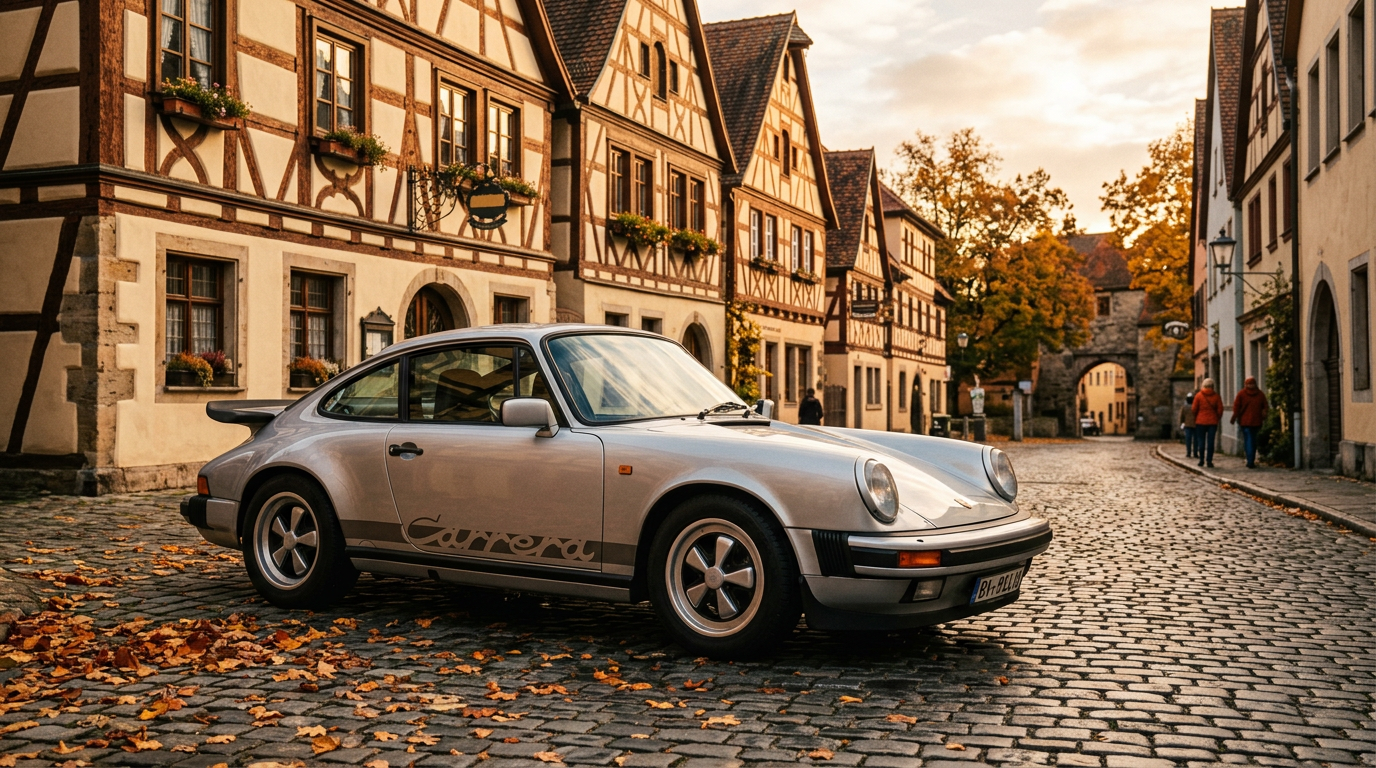
Germany has more classic cars, better documentation, and - for many models - lower prices than the United Kingdom. A Porsche 911 3.2 Carrera that commands £85,000 from a UK dealer can often be found for €72,000 in Stuttgart. A Mercedes W113 Pagoda listed at £130,000 in the UK may have an equivalent in Düsseldorf for €105,000. Even after shipping, customs duties, and VAT, the saving can be £5,000–£15,000 on a single transaction.
Before Brexit, buying a classic car in Germany and bringing it to the UK was a straightforward intra-EU transfer - no duties, no customs clearance, minimal paperwork. Since January 2021, the process has changed fundamentally. The car now crosses a customs border, and that border comes with forms, fees, and regulations that did not exist before.
This guide walks through every step of the process as it stands in 2026: finding the car, buying it, exporting from Germany, importing to the UK, customs clearance, DVLA registration, and the costs you need to budget for before you commit.
Search classic cars in Germany on Carseto →
Step 1: Find and Buy the Car in Germany
Browse thousands of classic cars listed in Germany.
Carseto aggregates listings from Mobile.de, AutoScout24, Classic Driver, and specialist dealers across Germany.
The buying process in Germany is covered in detail in our Buying a Classic Car in Germany guide. The key points for UK-bound buyers:
Where to search. Mobile.de, AutoScout24, Classic Driver, and Carseto all list German classic car inventory. Specialist dealers in the Stuttgart, Munich, and Rhineland areas carry the deepest selection of Porsche, Mercedes, and BMW. Private sales on Kleinanzeigen.de offer the best value but require more due diligence.
Pre-purchase inspection. For any car you are considering importing - where the round trip of travel, accommodation, and shipping represents a meaningful investment - a pre-purchase inspection by a German specialist before you travel is money extremely well spent. Budget €300–€500 for an independent inspection. If the car fails, you have saved the cost of a wasted trip and a bad purchase.
Payment. SEPA bank transfer is standard. International transfers from UK accounts to German accounts are straightforward through most banks, though transaction fees and exchange rates vary. For high-value transactions (above €50,000), consider a specialist currency broker (OFX, Wise, Currencies Direct) to improve the exchange rate - the saving on a six-figure purchase can be several hundred pounds.
The purchase contract (Kaufvertrag). Ensure it includes the VIN, the agreed price (in euros), the odometer reading, a statement of any known defects, and the seller's details. You will need this document for UK customs clearance.
Step 2: Deregister and Export from Germany
The seller deregisters the car at the local Zulassungsstelle (registration office). This is the standard Abmeldung process - the same whether the buyer is German, European, or British. The seller surrenders the number plates and receives a deregistration certificate.
If you plan to drive the car to the UK: Apply for Kurzzeitkennzeichen (short-term transit plates) valid for five days. These require a valid TÜV inspection, temporary insurance (obtainable online - you need an eVB number), your passport, and the purchase contract. Cost: approximately €50–€100 including plates and insurance. These plates allow you to drive legally through Germany, France, Belgium, and to the Channel crossing.
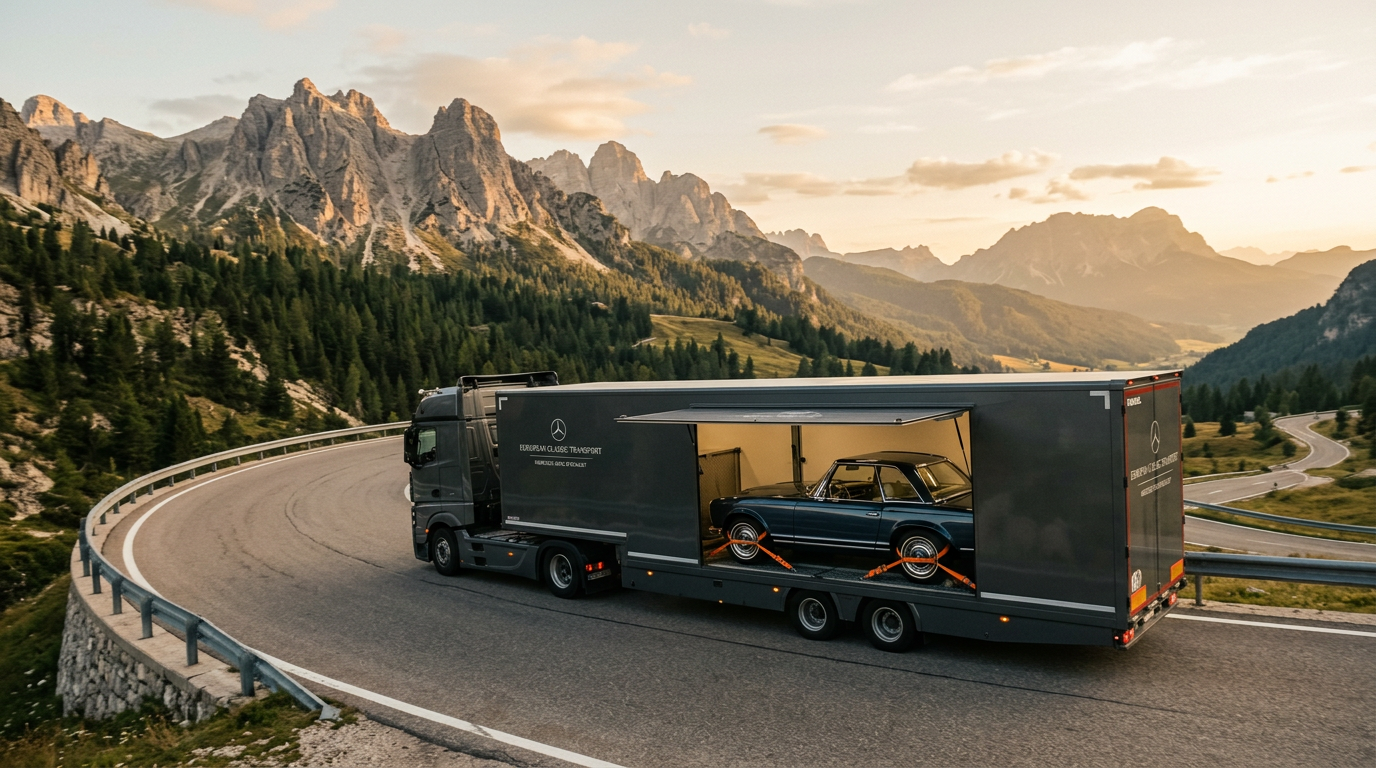
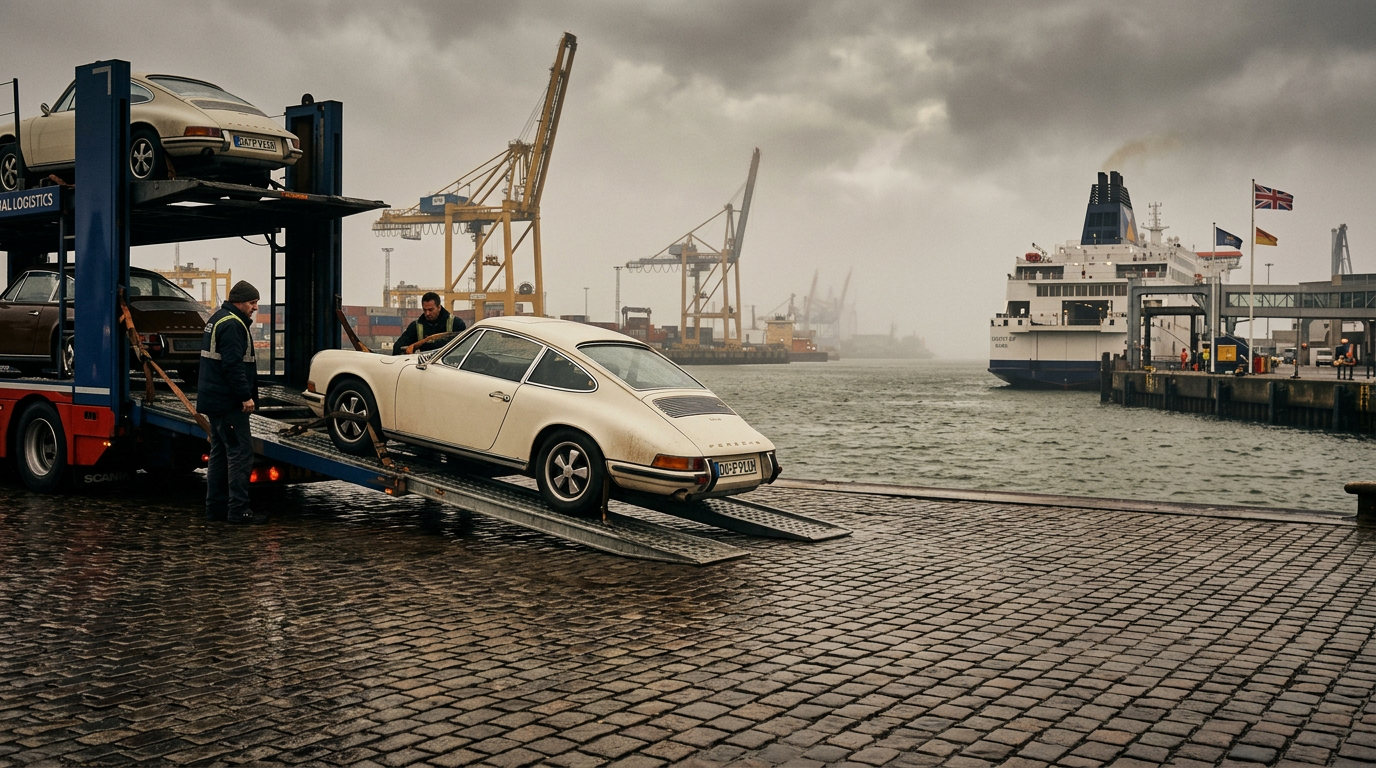
If you plan to transport the car: The deregistered car can be loaded onto a transporter without transit plates. Professional classic car transport from Germany to the UK typically costs £800–£1,500 for enclosed single-car transport, or £400–£800 for shared open transport. Ferry crossings (Calais–Dover, Dunkirk–Dover, Hook of Holland–Harwich) are included in most transport quotes.
Step 3: Customs Clearance at the UK Border
This is the step that did not exist before Brexit. When the car arrives in the UK - whether driven or transported - it must clear customs.
Customs Duty
Standard rate: 6.5% of the car's declared value (the purchase price on the Kaufvertrag, converted to GBP at HMRC's exchange rate).
Reduced rate for vehicles over 50 years old: Cars classified as "collector's pieces" under customs tariff heading 9705 may qualify for a reduced duty rate. The criteria are specific: the vehicle must be of historical or ethnographic interest, not primarily for its original purpose, and in its original state (not substantially restored using non-original parts). Consult a customs broker to determine eligibility - the saving can be meaningful on high-value cars.
VAT
UK VAT at 20% is charged on the declared value of the car plus the customs duty. This is the most significant cost of importing post-Brexit.
Example calculation:
- Purchase price: €80,000 (≈ £69,000 at illustrative exchange rate)
- Customs duty (6.5%): £4,485
- Subtotal for VAT: £73,485
- VAT (20%): £14,697
- Total import costs (duty + VAT): £19,182
This represents approximately 28% of the purchase price. For the import to make financial sense, the price differential between the German and UK markets must exceed this percentage - plus transport costs.
How to Clear Customs
You have two options:
Option A: Use a customs broker. A specialist broker handles the paperwork, submits the customs declaration, and arranges duty and VAT payment on your behalf. Cost: £150–£400. For a first import, this is the recommended approach. Brokers experienced with classic car imports understand the tariff classifications and can advise on reduced duty eligibility.
Option B: Self-declare. You can submit a customs declaration yourself through HMRC's Customs Handling of Import and Export Freight (CHIEF) or Customs Declaration Service (CDS). This requires an EORI number (free to obtain), the customs declaration form, the purchase contract, the shipping documentation, and payment of duty and VAT. The process is not inherently complex, but errors in classification can result in overpayment or delays.
Documentation Required for Customs
- Purchase contract (Kaufvertrag) showing the price paid
- German deregistration document
- Bill of lading or CMR (transport documentation)
- Your EORI number
- Vehicle identification (VIN, make, model, year)
- Evidence of the car's age (for reduced duty claims)
Step 4: DVLA Registration
Once the car has cleared customs and you have proof of duty and VAT payment, you can register the car with the DVLA.
The V55/5 Form
Imported vehicles are registered using form V55/5 (Application to Register and Tax an Imported Vehicle). You will need:
- The completed V55/5 form
- The German registration documents (Fahrzeugbrief / Zulassungsbescheinigung Teil II)
- Proof of customs clearance (showing duty and VAT paid)
- A valid MOT certificate (if the car is not MOT-exempt - see below)
- Valid insurance
- Proof of identity and address
- The registration fee (currently £55)
MOT Exemption
Classic cars built before 1 January 1977 are exempt from MOT testing in the UK. This means vehicles manufactured before that date can be registered without an MOT certificate. Vehicles manufactured from 1977 onwards require a valid MOT.
Important note: MOT exemption does not mean the car does not need to be roadworthy. The legal requirement to maintain a vehicle in a safe condition remains, regardless of MOT status. A car that is MOT-exempt but mechanically dangerous is illegal on UK roads.
IVA (Individual Vehicle Approval)
Most classic cars imported from within the EU are exempt from IVA if they were originally type-approved in the EU and are being imported in their original specification. However, significantly modified vehicles, kit cars, or vehicles without EU type approval may require an IVA test. Consult the DVSA (Driver and Vehicle Standards Agency) if there is any doubt about your car's status.
Age-Related Registration Numbers
If your classic car was manufactured before 1 January 1977, you can apply for an age-related registration number - a plate that reflects the car's year of manufacture rather than the year of import. This is purely cosmetic but adds to the car's presentation and period authenticity.
Step 5: Insurance
You will need UK motor insurance before the car can be legally driven on UK roads. For classic cars, specialist agreed-value insurance is essential - standard motor policies undervalue classics and provide inadequate coverage.
UK specialist insurers: Hagerty, Adrian Flux, Peter Best, Footman James, Lancaster Insurance, and ClassicLine all insure imported classic cars. Provide the insurer with the car's VIN, specification, and your agreed valuation. Most will require photographs of the car's condition.
For the transit period - from the ferry port to your garage - some transport companies provide temporary cover. Alternatively, arrange your UK policy to commence on the date of arrival.
Read more: Classic Car Insurance in Europe
The Full Cost Summary
Add your new classic to My Garage.
Document your collection, track values, and showcase your cars when you are ready.
For a car purchased in Germany for €80,000 (≈ £69,000):
| Item | Cost (approx.) |
|---|---|
| Purchase price | £69,000 |
| Transport (enclosed, DE→UK) | £1,200 |
| Customs duty (6.5%) | £4,485 |
| VAT (20% on value + duty) | £14,697 |
| Customs broker | £300 |
| DVLA registration | £55 |
| MOT (if required) | £55 |
| Total landed cost | £89,792 |
The key question: is the same car available in the UK for less than £89,792? If a UK dealer offers an equivalent example for £88,000, the import does not make sense. If UK pricing for equivalent cars is £95,000–£105,000, the import saves £5,000–£15,000. The arithmetic must work before you commit.
For lower-value cars (under €30,000): The fixed costs of transport, brokerage, and registration represent a larger percentage of the total. Importing a €15,000 car from Germany carries approximately £5,000–£6,000 in import costs - roughly 40% of the purchase price. At this level, the price differential between Germany and the UK must be very significant for the import to make financial sense.
Practical Tips for UK Buyers
Left-hand drive. Most German cars are LHD. This is not a problem for classic car ownership in the UK - many collectors prefer LHD for authenticity and Continental touring. However, LHD classics typically sell for 5–10% less than RHD equivalents in the UK market. Factor this into your resale calculation.
Speedometer conversion. German cars will have speedometers calibrated in km/h. For UK road use, you need a speed reference in mph. Options include a secondary mph decal on the existing speedometer, a replacement instrument, or a digital speed display. This is a minor detail but worth addressing before the MOT (if applicable).
Headlamp beam pattern. Continental European cars have headlamps designed for right-hand-side driving. In the UK, the beam pattern must be adjusted to avoid dazzling oncoming traffic. For most classic cars, this means fitting beam deflectors (simple adhesive patches) or adjusting the headlamp alignment. Some specialist classic car headlamps are available with switchable or UK-specific beam patterns.
Exchange rate risk. The GBP/EUR exchange rate directly affects the landed cost. A movement of 5% in the exchange rate on an €80,000 purchase changes the cost by approximately £3,500. For large transactions, consider locking in the exchange rate through a forward contract with a currency broker.
Frequently Asked Questions
Is it still worth importing a classic car from Germany to the UK after Brexit? For high-value cars where the price differential between Germany and the UK exceeds 28–30% (duty + VAT + transport), yes. For lower-value cars where fixed import costs represent a large percentage of the price, the calculation is tighter and must be assessed case by case.
How much duty and VAT do I pay? Customs duty is 6.5% of the declared value. VAT at 20% is charged on the value plus duty. Combined, this adds approximately 27.8% to the purchase price before transport and registration costs.
Can I avoid paying VAT on an imported classic car? No. VAT is due on all vehicle imports to the UK from outside the UK VAT area. There is no exemption for classic or historic vehicles. The duty rate may be reduced for vehicles over 50 years old classified as collector's pieces, but VAT remains at 20%.
How long does the import process take? The purchase and export from Germany can be completed in 1–3 days. Transport takes 3–7 days. Customs clearance takes 1–3 days. DVLA registration takes 2–4 weeks. Total: approximately 2–6 weeks from purchase to UK registration.
Do I need an IVA test for an imported classic car? Most EU-type-approved classic cars imported in original specification are exempt from IVA. Significantly modified vehicles or those without EU type approval may require testing. Consult the DVSA if uncertain.
The Arithmetic Must Work
Importing a classic car from Germany to the UK is more complex and more expensive than it was before Brexit. The duty and VAT alone add nearly 28% to the purchase price. But Germany's deeper supply, better documentation, and lower pricing mean the arithmetic still works for many cars - particularly in the €50,000–€200,000 range where the price differential between German and UK markets is consistently 15–25%.
The key is to calculate the full landed cost before you commit, not after. Know the purchase price, the exchange rate, the transport cost, the duty, the VAT, and the UK market value of equivalent cars. If the numbers work, Germany remains the best source market for classic cars in Europe - even with a customs border in the way.
Search classic cars in Germany on Carseto →
Related reading: Buying a Classic Car in Germany · Classic Car Insurance in Europe · Best Countries to Buy Classic Cars
This article is part of the Carseto Journal - market intelligence and stories from Europe's classic car world.