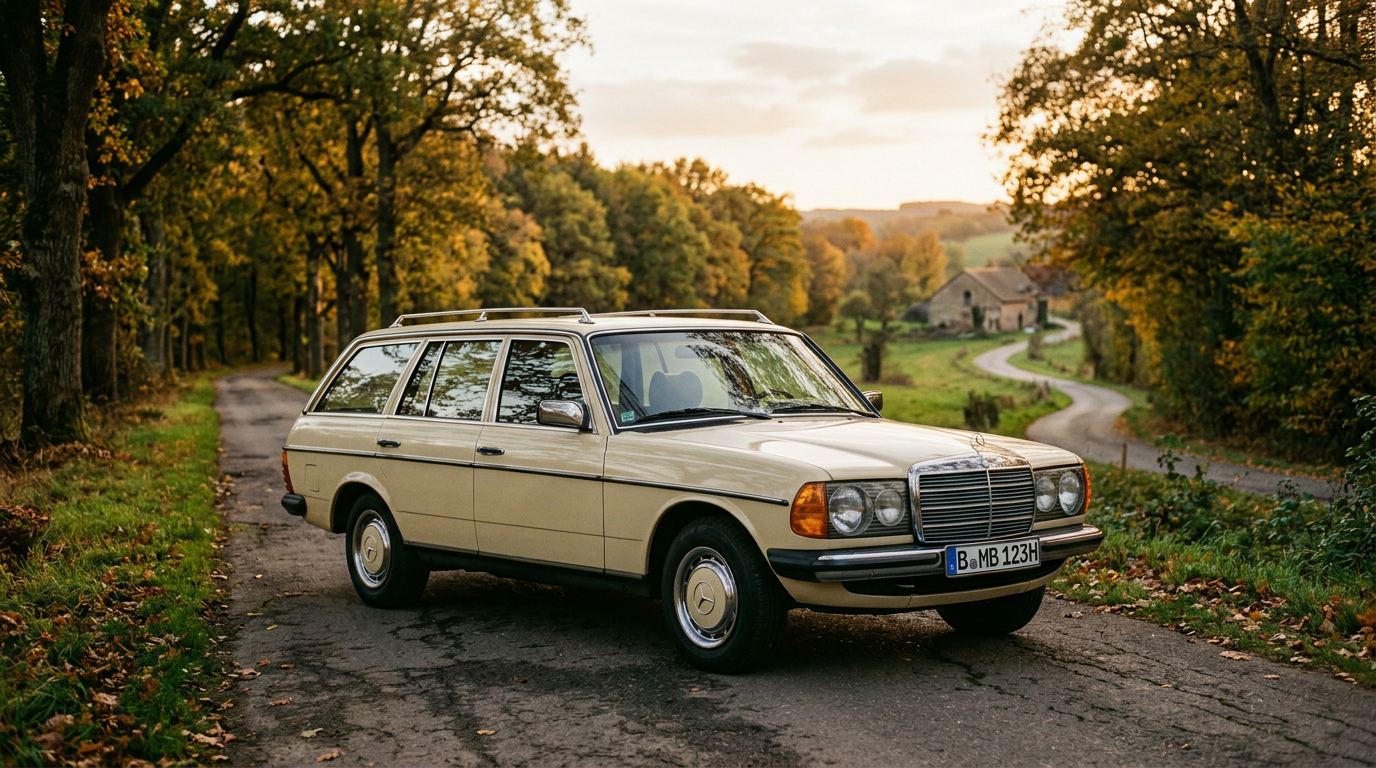
If you asked an engineer to design a car that would still be running reliably fifty years after it left the factory, the result would look remarkably like the Mercedes-Benz W123. Over-engineered is the word people use, though that implies excess - in the W123's case, the engineering was precisely right. Mercedes simply built the car to a standard that no manufacturer, including Mercedes-Benz, considers economically viable today.
Between 1976 and 1985, Mercedes produced approximately 2.7 million W123s across four body styles. A startling number survive. They still serve as taxis in Addis Ababa and Beirut. They tour European motorways in the hands of collectors who appreciate the vault-like solidity of the doors, the oil-painting smoothness of the straight-six engines, and the knowledge that the car beneath them was built to outlast its owner.
The W123 is not a fast car. It is not a flashy car. What it is, with total conviction, is an honest car - and in a classic car market increasingly crowded with speculative bubbles and overinflated values, honesty is worth a great deal.
Browse Mercedes W123 listings across Europe on Carseto →
The W123 Range - Sedan, Estate, Coupé
The W123 was offered in four body configurations, each with a distinct character and a different position in the collector market.
The sedan is the most common and the best value. Over two million were built, and clean examples remain readily available across Europe. A well-maintained 230E or 280E with documented service history can still be found for €5,000-€15,000 - extraordinary value for a car of this build quality. The sedan is the rational choice: practical, dignified, and perfectly suited to daily use or long-distance touring.
The estate (T-Model, internally S123) has developed a genuine cult following. Its combination of Mercedes-Benz build quality, a cavernous load space, and a silhouette that has aged into timelessness makes it one of the most desirable practical classics on the European market. Estate values now routinely exceed sedan equivalents by 30-50%, and the gap continues to widen. If you find a clean T-Model at sedan prices, buy it immediately.
The coupé (C123) is the connoisseur's choice. Pillarless construction gives the coupé cleaner lines and a more sporting presence than the sedan. Production numbers were lower, and values reflect the relative rarity. The coupé is the W123 for collectors who want something that turns heads at a concours - while still being a Mercedes you can drive home afterwards.
The long-wheelbase (V123) was produced in smaller numbers for limousine and hearse conversions. These are rare, niche, and priced accordingly - more curiosity than mainstream collectible.
Explore all Mercedes-Benz listings on Carseto →
Engine Guide - Which W123 Is the Keeper?
The W123's engine range spans four-cylinder petrols, inline-six petrols, and the legendary diesel and turbodiesel units. Your choice of engine defines the ownership experience.
The Petrol Sixes - 230E, 250, 280E
The petrol inline-sixes are the engines that make a W123 feel like a proper Mercedes. The 230E (M102, 136 hp) is the most common six-cylinder variant - refined, adequate, and economical to maintain. The 280E (M110, 185 hp) is the flagship - smooth, torquey, and genuinely quick by 1970s/80s standards. It is the engine that allows a W123 to keep pace with modern traffic without effort.
The petrol sixes are the choice for drivers who prioritise refinement and performance. They are slightly more expensive to maintain than the diesels (more complex injection systems, higher fuel consumption) but reward with a driving experience that justifies the word "prestige."
The Diesels - 200D, 240D, 300D, 300TD
The diesel engines are what gave the W123 its reputation for immortality. The OM615 (200D, 55 hp) and OM616 (240D, 65 hp) are naturally aspirated four-cylinder units that are mechanically near-indestructible. They are not fast - the 240D's 0-100 km/h time is measured in geological rather than automotive terms - but they will run for 500,000 km or more with nothing more than regular oil changes and occasional injector servicing.
The 300D (OM617, 80 hp) adds a five-cylinder diesel - smoother, more powerful, and the engine that became a global legend. The 300TD - the turbodiesel estate - is perhaps the most charismatic W123 variant: a car that can cruise at 160 km/h on the autobahn, carry a family across a continent, and do it on a tank of diesel that costs less than a restaurant meal. It is the ultimate companion for the European road trip.
The Four-Cylinder Petrols - 200, 230
The base four-cylinder petrol models (M115 and M102) are adequate but uninspiring. They lack the refinement of the sixes and the character of the diesels. They are the cheapest W123s to buy and perfectly functional - but they are not why people fall in love with the W123.
The keeper? For the driving enthusiast: the 280E (or 280CE coupé). For the touring companion: the 300TD turbodiesel estate. For the pragmatist: the 230E sedan.
European Pricing in 2026
See how W123 values trend over time on the Carseto Index.
Compare sedan, estate, and coupé prices across Europe.
The W123 remains one of the best-value classics in Europe, though prices are rising across all variants as the market recognises the car's quality.
Sedans
- 200D / 240D (driver quality): €3,000-€8,000
- 230E / 280E (driver quality): €5,000-€15,000
- 280E (excellent / low mileage): €15,000-€25,000
- 300D (any condition): €4,000-€12,000
Estates (T-Model)
- 230TE / 280TE (driver quality): €8,000-€20,000
- 300TD (driver quality): €10,000-€25,000
- 300TD (excellent): €25,000-€40,000
- AMG estate variants: €40,000-€80,000+
Coupés (C123)
- 230CE / 280CE (driver quality): €10,000-€25,000
- 280CE (excellent): €25,000-€40,000
- AMG coupé variants: €50,000-€100,000+
The AMG variants - both factory and aftermarket AMG-modified cars from the period - occupy the top of the market. Genuine AMG W123s are rare and increasingly sought-after, particularly the 280E AMG and 500TE (V8 conversion).
View the Mercedes W123 Price Guide on Carseto →
What to Look For When Buying
Rust
The W123 was built with high-quality steel and factory undercoating, but forty-plus years of European winters defeat even the best protection. Inspect these areas with particular care:
Floor pans - particularly under the rear seat. Lift carpets. This is the area most prone to moisture accumulation and hidden corrosion.
Rear wheel arches - the most visible rust location on the W123. Check both the outer arch lip and the inner arch panel.
Boot floor - water ingress through deteriorated boot seals pools here, particularly in the spare wheel well.
Front subframe mounts - structural, safety-critical, and often concealed by underseal.
Lower door edges - all four doors trap moisture in their lower skins.
Sills - structural members. Probe with care. A W123 with compromised sills is a major project.
A W123 with sound structure and moderate surface rust is a straightforward proposition. One with compromised structural members is a money pit. The distinction matters enormously.
Diesel Engines
The diesel engines are mechanically near-indestructible, but they are not immune to all problems. Check for excessive exhaust smoke - black smoke indicates injector issues (rebuildable, €400-€800), blue smoke indicates oil burning (more serious). Glow plug function is essential for cold starting - a failure to start in cold weather often points to glow plug or glow plug relay issues rather than engine problems. Listen for the injector pump's operation: it should tick rhythmically with no knocking or irregular beats.
Automatic Gearbox
The vast majority of W123s - particularly in European markets - were fitted with the 722.3 four-speed automatic. It is a strong, well-designed unit. Check the fluid colour: it should be red or light pink. Dark brown fluid indicates overdue servicing. Black fluid indicates potential internal damage. Shifts should be smooth and decisive. Slipping, delayed engagement, or harsh shifts suggest internal wear. Rebuilds run €1,500-€3,000.
The Vacuum System
This is the W123's most idiosyncratic feature. Vacuum pressure, generated by the engine (or a separate vacuum pump on diesels), controls the door locks, trunk release, climate control flaps, and - on later models - the cruise control. A single vacuum leak can cause a cascade of seemingly unrelated failures: doors that won't lock, a heater that blows only cold, a trunk that won't open. The good news: vacuum hoses are cheap and replaceable. The bad news: tracing leaks requires patience.
The Odometer Question
Many W123s, particularly those with diesel engines and high-mileage service histories, have been clocked. The five-digit odometer rolls over at 999,999 km, and some cars have done it twice. Verify mileage through service book stamps, MOT/TÜV certificates, and general condition assessment. A 300D with 400,000 km on documented original engine is a perfectly healthy car. A 230E with "80,000 km" and worn seats, a shiny steering wheel, and no service history probably is not.
Running Costs and Maintenance
The W123 is one of the cheapest classics to maintain in Europe. Annual servicing - oil change, filters, fluid checks, basic inspection - runs €200-€400 at an independent specialist. Even at a Mercedes-Benz dealer, costs are modest by classic car standards.
Parts availability is excellent. The Mercedes-Benz Classic Centre stocks a wide range, and the independent aftermarket is extensive. Mechanical parts are particularly well-served. Interior trim, rubber seals, and body panels are also available, though some items (specific dashboard components, certain chrome pieces) are becoming scarcer and correspondingly more expensive.
The W123 is also one of the most DIY-friendly classics in existence. The engine bay is spacious. Mechanical systems are straightforward. Workshop manuals are comprehensive and widely available. For the Wrench Turner segment, the W123 is an ideal platform: complex enough to be satisfying, simple enough to be achievable.
Insurance costs are minimal on an agreed-value basis. In Germany, H-Kennzeichen registration provides further savings on tax and insurance.
The Investment Case
Track your classic in My Garage.
Document your collection, get value insights, and list when you're ready to sell.
The W123 was long considered too common and too utilitarian to be a "real" classic. That perception is changing rapidly. Prices have risen 40-60% across most variants in the past five years, driven by a growing recognition that the W123's build quality, design integrity, and engineering philosophy are irreplaceable.
The estate is the strongest investment within the range, benefitting from both the W123's inherent qualities and a broader cultural shift toward practical classics. Clean 300TD examples that sold for €12,000 five years ago now command €25,000-€35,000. The trajectory shows no sign of slowing.
The coupé is the connoisseur's play - lower production numbers, more elegant lines, and a collector appeal that distinguishes it from the utilitarian sedan. Coupé values are rising steadily, with AMG variants appreciating most rapidly.
Even the sedan offers investment potential at current prices. A well-maintained 280E sedan at €10,000-€15,000 - representing one of the finest automotive engineering achievements of the twentieth century - is, by any reasonable measure, underpriced relative to what it is.
Where to Buy a W123 in Europe
Germany offers the widest selection and the best-documented histories. German W123 enthusiasts maintain meticulous records, and the TÜV inspection system provides a documented maintenance trail. Pricing is competitive due to large supply.
Greece, Portugal, and North Africa are source markets for dry-climate survivors. These cars typically have minimal rust but high mileage. Mechanical condition is the priority for inspection on Southern European and African-market cars.
The United Kingdom has a dedicated but smaller W123 community. Right-hand-drive examples carry a modest premium. The UK specialist market is well-established, particularly for the estate.
Poland has a rapidly growing W123 community, especially for the estate. Prices are lower than Western European markets, but inspect structural condition carefully - Polish winters and road salt are demanding.
Search Mercedes W123 listings across Europe on Carseto →
Frequently Asked Questions
How much does a Mercedes W123 cost? Clean sedans (230E, 280E) range from €5,000 to €25,000 depending on condition and specification. Estates command €8,000 to €40,000, with the 300TD turbodiesel at the top. Coupés run €10,000 to €40,000 for standard models. AMG variants can exceed €100,000.
Is the Mercedes W123 a reliable classic car? Extremely. The diesel engines in particular are legendary for their longevity - 500,000+ km on the original engine is not uncommon. The petrol sixes are nearly as robust. Regular maintenance is all the W123 asks, and it returns decades of faithful service.
Which W123 engine is best? For driving pleasure: the 280E inline-six. For longevity and touring: the 300D or 300TD turbodiesel. For value and simplicity: the 230E.
Should I buy a W123 sedan or estate? The estate is the more desirable variant and commands higher prices. If you can find one in good condition at a fair price, the estate is the better long-term choice. The sedan offers more selection and lower entry costs.
Is the Mercedes W123 a good investment? Increasingly, yes. Prices have risen 40-60% across most variants over five years, and the trend shows no sign of reversing. The estate and coupé are the strongest investment picks. Even sedans at current prices offer compelling value.
What's the most common problem with the W123? Rust. The W123's mechanical systems are robust, but the body - like any 40-year-old European car - is vulnerable to corrosion. A thorough inspection of floor pans, sills, wheel arches, and subframe mounts is essential before purchase.
Honest Transportation Elevated to Art
The Mercedes W123 does not shout. It does not perform. It does not demand attention or validation. It simply does what it was designed to do - transport its occupants across continents with quiet competence and dignified comfort - and it does it better, for longer, than almost any car ever built.
In a market full of cars that promise excitement, the W123 offers something rarer: integrity. Every control, every surface, every engineering decision reflects a philosophy that put longevity and quality ahead of fashion and profit margin. Forty years later, that philosophy feels more valuable than ever.
Thinking of selling your W123? List it on Carseto →
Related reading: Mercedes W113 Pagoda Price Guide · Porsche 911 Buyer's Guide · 10 Classic Cars Under €30,000
This article is part of the Carseto Journal - market intelligence and stories from Europe's classic car world.