Aston Martin is the marque that refuses to behave like a sensible business. Chronically underfunded, perpetually on the edge of insolvency, and stubbornly committed to building cars that prioritise character over commercial logic, it has survived seven bankruptcies and emerged each time with another car too beautiful and too engaging to be dismissed by the market that should have killed it.
The result, for collectors, is a catalogue of grand tourers that combine British craftsmanship, motorsport heritage, and a handbuilt quality that no volume manufacturer has ever matched. Every classic Aston Martin was assembled by a small team of highly skilled craftsmen in Newport Pagnell, Buckinghamshire. Each car took approximately 2,500 man-hours to build. Hand-finished aluminium bodies, hand-stitched leather interiors, hand-assembled engines: the attention to detail is evident in every surface and every mechanical action.
This guide covers the classic Aston Martin range from the DB5 through the V8 Vantage and into the Virage era, the cars that most buyers consider when entering the marque.
Browse Aston Martin listings on Carseto →
The DB5 (1963–1965)
Browse Aston Martin listings across Europe on Carseto.
From Virage coupés to V8 Vantages and DB6 saloons in the UK, Germany, and Switzerland.
The DB5 needs no introduction. James Bond's car in Goldfinger (1964) made it the most famous automobile in cinema history. Only 1,059 were built, a tiny number that, combined with the Bond association and the car's genuine engineering excellence, has elevated the DB5 to blue-chip collector status.
The DB5 is powered by a 4.0-litre twin-cam inline-six producing 282 hp, mated to a ZF five-speed manual or (rarely) a Borg-Warner three-speed automatic. It is a genuine 145 mph grand tourer: fast, refined, and beautifully proportioned.
European pricing: €500,000–€900,000 for standard DB5 saloons. Convertibles exceed €1,000,000. Bond-provenance cars (those used in films or promotional work) are in a different category entirely.
The DB5 is not a car for most buyers. It is a car for Heritage Custodians and Investor-Collectors operating at the highest level of the market.
The DB6 (1965–1971)
The DB6 replaced the DB5 with a longer wheelbase, a Kamm tail for improved high-speed stability, and better interior space. It shared the 4.0-litre twin-cam six (later enlarged to 4.2 litres in Vantage specification) and offered a marginally more civilised grand touring experience.
Approximately 1,788 DB6s were built. More than the DB5, but still a very small number. The DB6 has historically traded at a discount to the DB5, perceived as "the one that isn't Bond's car." This perception is increasingly challenged by enthusiasts who consider the DB6 the better-driving, better-proportioned car of the two.
European pricing: €250,000–€500,000. The DB6 Volante (convertible) commands premiums of 30–50% over the saloon. Vantage-specification cars (high-compression engine, triple Weber carburettors) attract a 10–20% premium.
The DB6 is the Aston Martin for the collector who knows the marque. It offers 90% of the DB5 experience at 50–60% of the price.
The V8 / V8 Vantage (1969–1989)
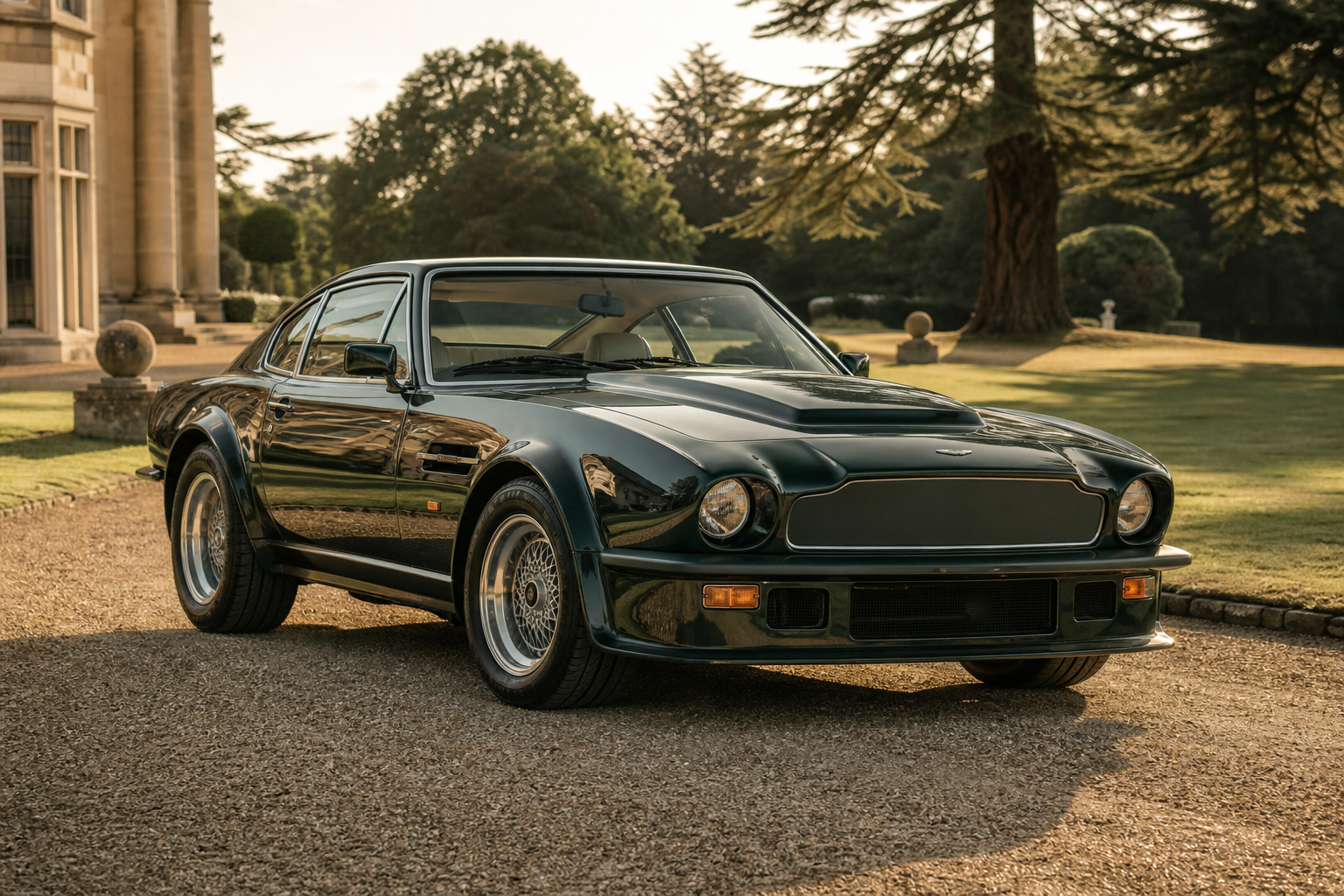
The V8, known colloquially as the "AM V8," was Aston Martin's longest-serving model, produced in various forms for twenty years. Its 5.3-litre all-aluminium V8, designed by Tadek Marek, produced approximately 315 hp in standard form and 380–432 hp in Vantage specification. These were the most powerful production cars of their era, faster than contemporary Ferraris in a straight line.
The V8 Vantage (1977–1989) defines this generation. The deep front air dam, blanked-off grille, and flared wheel arches give it a visual aggression that the standard V8 lacks. The Vantage was the first Aston Martin to carry the Vantage name as a model designation rather than an engine option.
European pricing:
- V8 Saloon (standard): €100,000–€200,000
- V8 Vantage: €200,000–€400,000
- V8 Volante (convertible): €120,000–€280,000
- V8 Vantage Volante: €300,000–€500,000+
The V8 range offers the most dramatic Aston Martin experience at prices below the DB5. The Vantage, in particular, has appreciated strongly. Its combination of brute power, handbuilt quality, and unmistakable presence makes it one of the most charismatic grand tourers ever produced.
The Virage / V8 (1989–2000)
The Virage replaced the original V8 series with a modernised body (designed by John Heffernan and Ken Greenley) on an updated platform. The 5.3-litre V8 continued in revised form, producing 330 hp (later 550 hp in supercharged Vantage V550 specification).
The Virage era Astons are the most affordable route into Newport Pagnell-built ownership. Standard Virages can be found for €60,000–€120,000, and the later V8 Coupé and Volante (1996–2000) represent the final evolution of the hand-built V8 before the DB7 moved production to a more industrialised process.
The Vantage V550/V600 (supercharged, 550–600 hp) is the ultimate expression of the Newport Pagnell V8. Staggeringly fast and brutally powerful, it has appreciated significantly in recent years. Prices: €250,000–€400,000.
What to Look For
See how Aston Martin values trend over time.
Compare models and spot the best entry points for your budget.
Body and Structure
Classic Aston Martins use aluminium body panels over a steel platform structure. The aluminium does not rust, but the steel substructure does, particularly the sills, floor, inner wings, and mounting points for the suspension and mechanical components.
The aluminium panels can suffer from galvanic corrosion where they meet dissimilar metals. Check around the windscreen surround, the door hinge area, and the boot aperture.
Panel damage on aluminium bodies is more expensive to repair than on steel. Aluminium panel beating is a specialist skill, and Aston Martin body panels are hand-formed; replacement panels are not available off the shelf.
Engine
The twin-cam inline-six (DB5, DB6) and the V8 (V8 series, Virage) are both robust engines that reward proper maintenance. Check for oil leaks (particularly from the rear main seal on the V8), coolant condition, and head gasket integrity on the six-cylinder.
The V8 engines use a complex set of Weber carburettors (early cars) or fuel injection (later cars). The carburettor setup requires specialist knowledge to tune properly. A maladjusted set of four twin-choke Webers produces poor running, high fuel consumption, and frustration. Ensure the carburettors have been properly set up by a specialist, or budget for the work.
Running Costs
This is where Aston Martin ownership demands honest self-assessment. Classic Astons are not cheap to maintain. They were hand-built, and they require hand-maintenance, which means specialist labour at specialist rates.
Annual service at an Aston Martin specialist: €1,500–€3,000 for the V8 range. The six-cylinder DB5/DB6 is somewhat less.
Parts are available through Aston Martin Works (the official heritage centre at Newport Pagnell), Aston Workshop (Beamish), and independent specialists. Parts are not cheap; these are low-volume, hand-finished components. A set of exhaust manifolds for the V8 costs more than a complete exhaust system for a Porsche 911.
The critical question before buying any Aston Martin: can you afford the car, and can you afford to maintain it? These are two separate questions, and the answer to the second is frequently more important than the answer to the first.
Where to Buy
The United Kingdom is the primary market and has the deepest specialist infrastructure. Aston Martin Works at Newport Pagnell, Aston Workshop in County Durham, and Nicholas Mee in London are among the leading specialists. UK prices are the highest but reflect the quality of preparation and the strength of the specialist network.
Continental Europe (Germany, Switzerland, the Netherlands) offers LHD examples at often competitive prices. For buyers seeking a touring Aston for Continental use, a European-specification car makes practical sense.
Search Aston Martin listings across Europe on Carseto →
Frequently Asked Questions
Track your classic in My Garage.
Document your collection, get value insights, and list when you're ready to sell.
How much does a classic Aston Martin cost? Virage: €60,000–€120,000. V8 Saloon: €100,000–€200,000. DB6: €250,000–€500,000. V8 Vantage: €200,000–€400,000. DB5: €500,000–€900,000. The range is vast, with a classic Aston Martin available at many price points.
Are classic Aston Martins expensive to maintain? Yes. Annual maintenance costs of €3,000–€8,000 are realistic for V8-era cars. Parts are available but not cheap. Specialist labour is essential. Budget honestly before buying.
Which classic Aston Martin is the best value? The Virage (1989–2000) offers Newport Pagnell build quality and the V8 experience at the lowest entry point. The DB6 offers the best balance of heritage, driving experience, and value relative to the DB5.
Is a classic Aston Martin a good investment? The DB5 and V8 Vantage have proven long-term appreciation. The DB6 is increasingly recognised as undervalued. The Virage is stable and gently appreciating. All variants reward originality, low mileage, and documented history.
Made by Hand, Owned by Choice
A classic Aston Martin is not the rational choice. It is not the cheapest to buy, the cheapest to maintain, or the most reliable car in any price bracket. What it offers, though, is something that exists nowhere else in the automotive world: a car handbuilt by craftsmen in a small English factory, powered by an engine assembled by a single technician, finished in leather cut and stitched by artisans.
You do not buy an Aston Martin because it makes sense. You buy one because nothing else will do.
Find your Aston Martin on Carseto →
Related reading: Jaguar E-Type Buyer's Guide · The Golden Age: 1960s & 1970s Classics · Classic Car Insurance in Europe
Questo articolo fa parte del Carseto Journal - intelligence di mercato e storie dal mondo delle classiche europee.