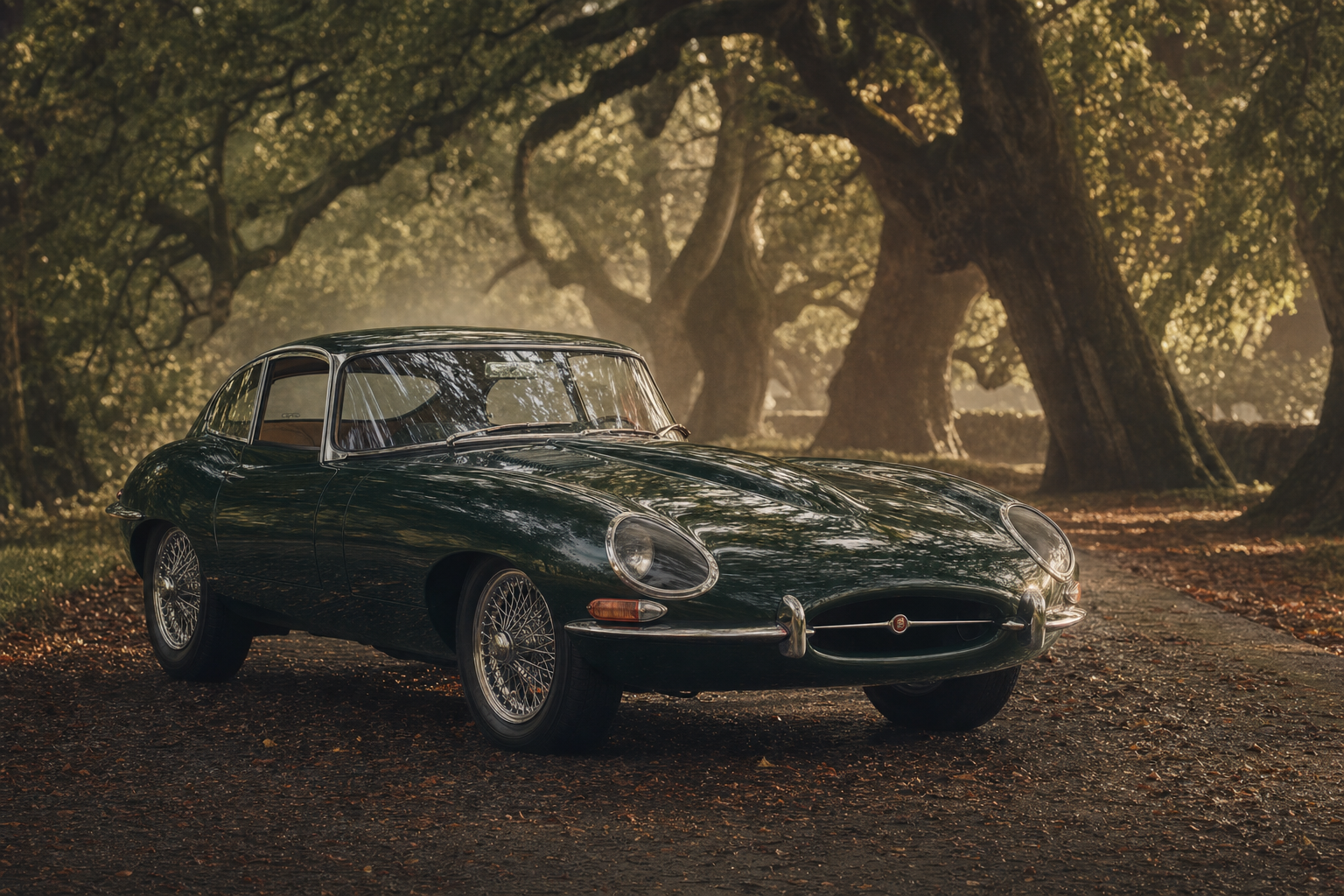
Enzo Ferrari called it the most beautiful car ever made. He was right, and he was not a man given to complimenting his competitors. The Jaguar E-Type, launched at the Geneva Motor Show in March 1961, remains the standard against which automotive beauty is measured. Its long bonnet, delicate oval grille, and fastback coupé roofline describe a shape so perfectly proportioned that sixty-five years of subsequent automotive design have not produced its equal.
The E-Type was also, at launch, the fastest production car in the world. Its 3.8-litre twin-cam inline six produced 265 hp, and the factory claimed 150 mph. It cost £2,097, less than half the price of its nearest rivals from Ferrari and Aston Martin. The combination of beauty, performance, and accessibility made the E-Type the most important sports car of its era.
In 2026, the E-Type market presents a genuine opportunity. Jaguar values have softened significantly: the Hagerty Best of British index dropped 21.4% in 2025, and E-Type prices have come down from their 2017–2019 peaks. For buyers who have always wanted an E-Type, this correction creates a more rational entry point than the market has offered in years.
Browse Jaguar E-Type listings on Carseto →
Series 1 (1961–1968) — The Icon
Browse Jaguar E-Type listings across Europe on Carseto.
From Series 2 projects to concours Series 1 Roadsters in the UK, France, and Germany.
The Series 1 is the definitive E-Type: the car that Enzo admired, the car with the covered headlamps, the toggle switches, and the purity of Malcolm Sayer's original aerodynamic design.
Two body styles were offered: the Fixed Head Coupé (FHC) and the Open Two-Seater (OTS/Roadster). The Roadster is the more valuable, but the Coupé, with its elegant fastback roofline and practical hatchback, is the better-looking car by many accounts.
Engine variants: The 3.8-litre (1961–1964) is the original and most sought-after engine, prized for its period character and motorsport associations. The 4.2-litre (1964–1968) brought more torque, a better gearbox (full synchromesh replacing the moss box), improved brakes, and more comfortable seats. Most buyers consider the 4.2 the better car; purists and investors prefer the earlier 3.8.
European pricing (2026, post-correction):
- Series 1 3.8 Roadster: €130,000–€250,000
- Series 1 4.2 Roadster: €120,000–€220,000
- Series 1 3.8 FHC: €90,000–€180,000
- Series 1 4.2 FHC: €80,000–€160,000
- Series 1 2+2 (longer wheelbase, 1966–1968): €55,000–€120,000
The 2+2, with its longer roofline, higher roof, and additional rear seats, is the most affordable Series 1 and increasingly recognised as a practical touring alternative to the two-seater.
Series 2 (1968–1971) — The Compromise
US safety and emissions regulations forced changes that altered the E-Type's appearance: open headlamps (replacing the glass-covered units), larger bumpers, raised ride height, and emissions equipment that reduced power. The wraparound rear bumper and enlarged tail lights are the most visible external changes.
The Series 2 is the least collectible E-Type. Purists consider the open headlamps a downgrade, and the emissions-hobbled engine lacks the Series 1's urgency. However, the Series 2 is also the most affordable route into E-Type ownership, and driving one gives you ninety percent of the experience at sixty percent of the price.
European pricing:
- Series 2 Roadster: €70,000–€140,000
- Series 2 FHC: €55,000–€100,000
- Series 2 2+2: €40,000–€80,000
For buyers who want to drive an E-Type rather than invest in one, the Series 2 is an increasingly compelling proposition at current values.
Series 3 (1971–1975) — The V12
The Series 3 introduced Jaguar's legendary 5.3-litre V12 engine, a silky, smooth, powerful unit that transformed the E-Type's character from sporting to grand touring. The Series 3 was offered only in Roadster and 2+2 Coupé form (no short-wheelbase FHC).
The V12 is a wonderful engine, one of the smoothest production engines ever made. But it changed the E-Type's personality fundamentally. Where the six-cylinder cars were taut and sporting, the V12 is relaxed and effortless. It is a different kind of pleasure.
The Series 3 has been hit hardest by the current Jaguar market correction. Values have fallen 20–30% from their peaks, and the V12 2+2 Coupé now represents one of the most affordable routes into twelve-cylinder motoring.
European pricing:
- Series 3 Roadster: €80,000–€160,000
- Series 3 2+2: €45,000–€90,000
What to Look For
Rust
The E-Type rusts. It rusts in the sills, the floor pans, the bonnet frame, the front subframe, the boot floor, the door bottoms, the rear wheel arches, and the monocoque structure that carries all the mechanical loads. A beautiful E-Type can conceal terminal structural corrosion beneath gleaming paintwork, and many do.
Every E-Type inspection must include a thorough examination of the monocoque tub, the structural centre section that supports the passenger compartment. If this is compromised, the car is a major restoration project regardless of how the exterior presents. Access requires lifting carpets, inspecting from beneath, and probing vulnerable areas.
The E-Type's long forward-hinged bonnet is a subframe in its own right, carrying the engine, suspension, and front bodywork. Corrosion in the bonnet frame is common, expensive to repair, and affects the car's structural geometry. A replacement bonnet frame from Martin Robey or British Motor Heritage costs €3,000–€5,000 before fitting.
Engine
The inline-six (Series 1 and 2) is a robust, well-understood engine with excellent parts availability. Check for head gasket weep (common), oil leaks from the rear main seal, and timing chain condition. Rebuilds cost €5,000–€10,000 for a quality job.
The V12 (Series 3) is reliable when properly cooled and maintained, but overheating is its nemesis. The cooling system is barely adequate for the heat generated; check for evidence of overheating (warped heads, failed head gaskets). A V12 rebuild is a £10,000–£20,000 proposition.
Electrics
Lucas electrics. The reputation is earned. Earth connections corrode, switches fail, instruments become erratic. A full rewiring (€1,500–€3,000) is a common and worthwhile investment on any E-Type you intend to use regularly.
The Market Correction — Opportunity or Warning?
See how Jaguar values trend over time.
Compare series and spot the best entry points during the current correction.
The Jaguar market correction of 2024–2025 deserves careful analysis. E-Type values have fallen 15–25% from their peaks, and the broader Jaguar marque (XK150, XJ6, XJS) has softened further. The question for prospective buyers: is this a buying opportunity or the beginning of a longer decline?
The case for opportunity: The E-Type's beauty, historical significance, and cultural impact are permanent. No amount of market fluctuation changes what the car is. Current pricing represents a return to rational levels after a speculative over-reach, and rational levels for a car this beautiful are still substantial.
The case for caution: Generational shifts are real. The buyers who drove the E-Type market to its peaks were predominantly baby boomers. As this generation sells and Gen X enters the market, preferences tend toward 1980s and 1990s sports cars over 1960s British roadsters. Whether the E-Type's universal beauty transcends generational preference, or whether it is primarily a boomer collectible, remains to be seen.
The pragmatic view: Buy an E-Type because you want to own and drive the most beautiful car ever made. If it also appreciates, that is a welcome dividend. If it holds its value at current levels (the most likely medium-term outcome for the best examples) that is a satisfactory result for a car that provides this level of aesthetic and driving pleasure.
Running Costs
Annual service at an independent Jaguar specialist: €600–€1,200 for the six-cylinder, €800–€1,500 for the V12. Parts availability is excellent. British Motor Heritage, SNG Barratt, Martin Robey, and others maintain comprehensive catalogues.
Insurance on an agreed-value basis: competitive, reflecting the E-Type's established market position. UK specialist insurers offer strong terms.
The E-Type rewards regular use. Cars that sit dormant develop problems (seized callipers, perished seals, fuel system corrosion) that running prevents.
Where to Buy
The United Kingdom has the deepest E-Type specialist network. UK prices are the highest in Europe but reflect strong preparation standards and buyer protections.
Continental Europe, particularly France, Italy, and Germany, offers LHD examples at typically 10–15% below UK pricing. LHD E-Types are preferable for Continental use and are increasingly accepted in the UK market.
Search Jaguar E-Type listings across Europe on Carseto →
Frequently Asked Questions
Track your classic in My Garage.
Document your collection, get value insights, and list when you're ready to sell.
How much does a Jaguar E-Type cost in 2026? Series 1 Roadsters: €120,000–€250,000. Series 2 Roadsters: €70,000–€140,000. Series 3 V12 2+2: €45,000–€90,000. The market has corrected 15–25% from peak levels, creating more accessible entry points.
Is the E-Type a good investment in 2026? At current corrected prices, the E-Type offers reasonable value. The strongest investment case is for Series 1 cars with documented history and matching numbers. Series 2 and 3 cars are more suited to buyers prioritising driving pleasure over financial returns.
Which E-Type series is best? Series 1 for beauty and collectibility. Series 2 for value. Series 3 for a different kind of driving experience (V12 smoothness versus six-cylinder sporting character). The Series 1 4.2 FHC is many enthusiasts' choice as the best all-round E-Type.
Does the E-Type rust badly? Yes. Rust is the E-Type's primary weakness. Thorough inspection of the monocoque tub, bonnet frame, sills, and floor pans is essential before any purchase.
Beautiful, Despite Everything
Yes, it rusts. Yes, the electrics are hopeful rather than reliable. And yes, a modern hot hatchback will embarrass it in a straight line. None of that matters. The E-Type is the most beautiful car ever made, and beauty of this order has a value that outlasts every practical objection.
Related reading: Porsche 911 Buyer's Guide · Mercedes W113 Pagoda Price Guide · European Classic Car Market 2026
Questo articolo fa parte del Carseto Journal - intelligence di mercato e storie dal mondo delle classiche europee.