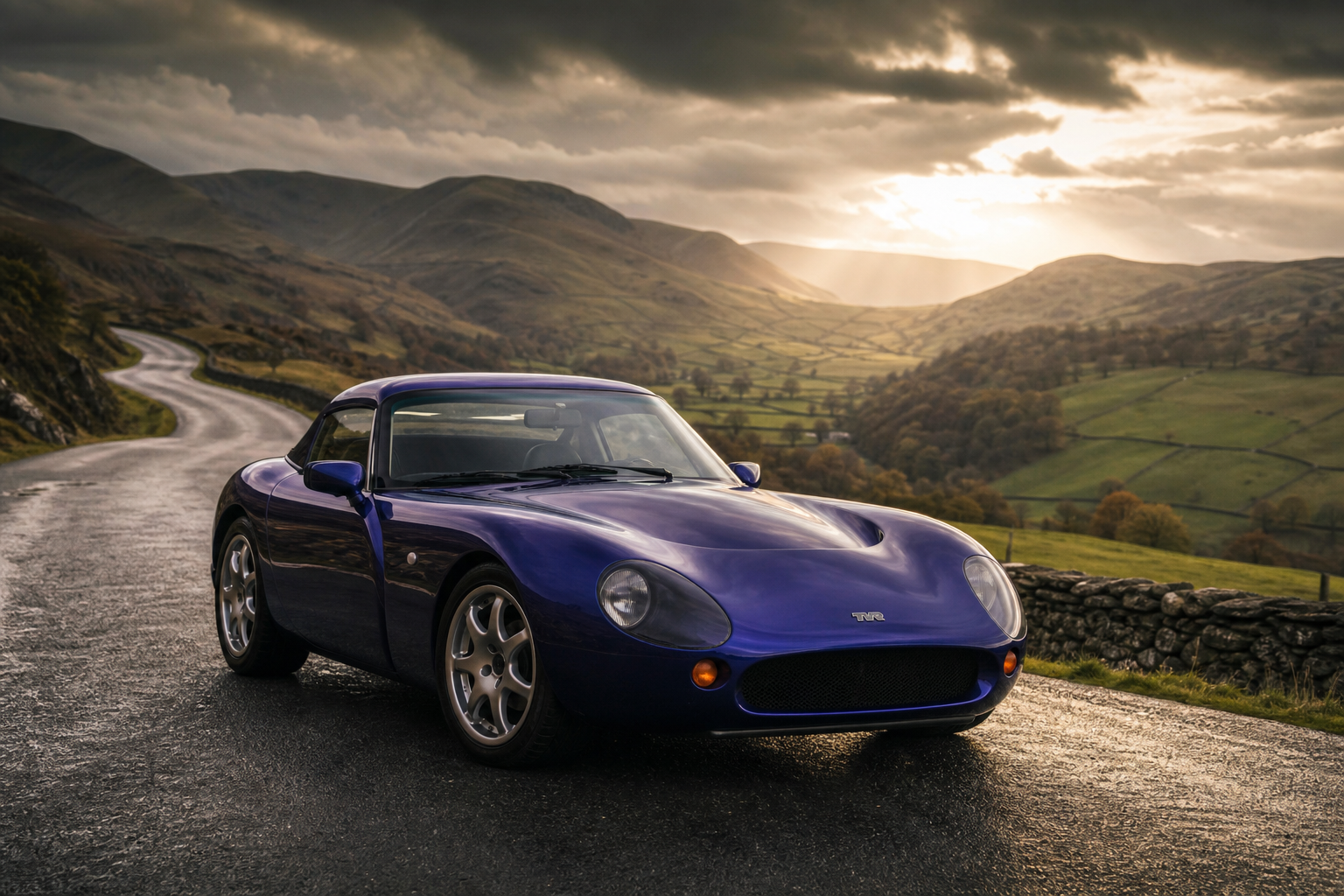
TVR is the car company that could only have come from Blackpool. For decades, a small factory on an industrial estate in Lancashire produced some of the most visceral, uncompromising, and frankly dangerous sports cars ever to wear a number plate. No traction control. No ABS on most models. No airbags. No electronic safety net of any kind between the driver's right foot and the rear tyres. Just a fibreglass body, a large engine, and the understanding that if things go wrong, you have only yourself to blame.
This absence of electronic intervention is precisely what makes a TVR unlike anything else on the road. In an era where even hot hatchbacks ship with fourteen stability-management systems, a TVR delivers raw, unfiltered driving feedback that modern engineering has methodically removed. The steering talks. The throttle responds instantly. The chassis tells you exactly what the rear tyres are doing, corner by corner, moment by moment. For an attentive driver, this is addictive. For an inattentive one, it is deeply unforgiving.
TVRs also represent strong value in the 2026 market. A Griffith 500 or Chimaera 500, with Rover V8 power, a sub-1,100 kg kerb weight, and a 0–60 time under five seconds, can be bought for €15,000–€30,000. Nothing else in the European market offers this level of performance, drama, and character for the money.
Browse TVR listings on Carseto →
The TVR Range
Browse TVR listings across Europe on Carseto.
From Chimaera 450s to rare Sagaris examples in the UK, Netherlands, and Germany.
Griffith (1991–2002)
The car that revived TVR. The Griffith combined Peter Wheeler's vision of a lightweight, analogue sports car with the Rover V8 engine in 4.0-litre (240 hp) and 4.3/5.0-litre (280–340 hp) forms. The body was designed in-house and remains one of the most beautiful shapes to come out of Britain: curvaceous, muscular, and free of the fussiness that afflicted many 1990s designs.
The Griffith is the TVR most buyers should consider first. It is the most developed, the best-understood, and in Rover V8 form the most affordable to maintain. European prices sit at €18,000–€35,000 for the 500.
Chimaera (1992–2003)
The Chimaera is the Griffith's more civilised sibling, longer and wider, with a proper boot and a softer ride. It shares the Rover V8 engine range and the tubular steel chassis. Where the Griffith demands total engagement, the Chimaera lets you relax a little. It is also the most produced TVR of the modern era (over 6,000 built) and the most affordable.
European prices: €12,000–€25,000. At the lower end of that range, the Chimaera is one of the most spectacular-value sports cars available in Europe.
Cerbera (1996–2003)
The Cerbera introduced TVR's own engines: the AJP8 4.2-litre V8 (350 hp) and the Speed Six 4.0-litre straight-six (350–400 hp). These are the most powerful and dramatic TVRs of the era, but they also carry significantly higher maintenance risk than the Rover V8-powered cars. The AJP8 is a flat-plane-crank V8 that revs like a racing engine and sounds like nothing else. The Speed Six is turbine-smooth and immensely powerful.
European prices: €20,000–€40,000. The Cerbera is the enthusiast's TVR, the one that demands the most knowledge and rewards it with the most intense experience.
Tuscan (1999–2006)
The Tuscan was TVR's most ambitious car, styled in-house with an alien-organic design language that divided opinion violently. The Speed Six engine (3.6 or 4.0-litre, 350–400 hp) provided shattering performance. The Mk1 was the most raw TVR since the Griffith. No door handles (you pushed a hidden button), no locks (you used a remote), and a driving experience that required total commitment.
The Mk2 (from 2005) added some refinement, including conventional door handles, but retained the essential TVR character.
European prices: €25,000–€50,000. The Tuscan is the TVR for collectors who appreciate its design as art and its dynamics as motorsport.
Sagaris (2004–2006)
The final TVR from the Peter Wheeler era. Approximately 211 were built. The Sagaris combined the Speed Six engine (406 hp) with an aggressive aero package, a stripped-out interior, and the most extreme chassis setup of any road TVR. It is the rarest and most collectible modern TVR.
European prices: €55,000–€90,000. Limited production, a defined build number, and growing collector recognition make the Sagaris the blue-chip TVR.
What to Look For
The Chassis
TVRs use a tubular steel backbone chassis that is generally strong but can corrode, particularly where the outrigger tubes meet the main spine and at the suspension mounting points. The chassis hides beneath the fibreglass body, making visual inspection difficult without lifting the car.
With the car on a ramp, inspect every chassis tube for surface rust, bubbling, or perforation. Pay particular attention to the wishbone mounting points, the spring/damper mounting areas, and any joint where tubes meet. A compromised chassis tube is a safety issue and a significant repair cost (€1,000–€3,000+ per tube, depending on location).
The Fibreglass Body
TVR bodies are hand-laid fibreglass. They do not rust, but they can crack around stress points like the windscreen surround, door apertures, and bonnet hinges. Star-crazing (a network of fine cracks in the gelcoat) and stress fractures from chassis flex are also common.
Body repairs are specialist work but not prohibitively expensive. A good fibreglass specialist can repair cracks and refinish panels for €500–€1,500 per area.
Rover V8 (Griffith, Chimaera)
The Rover V8 is one of the most understood engines in British motorsport and classic car culture. Lightweight, tuneable, and backed by an enormous parts ecosystem, it has aftermarket support that few engines can match. Common issues include coolant leaks (head gaskets, water pump), timing chain wear, and oil leaks from the rear main seal. A rebuild costs €2,000–€4,000, significantly less than TVR's own engines.
TVR Speed Six and AJP8
TVR's own engines are brilliant, powerful, characterful, and sonically extraordinary. They are also less proven than the Rover V8 and can be expensive to rebuild.
Speed Six: Timing chain issues, head gasket failures, and oil consumption are the known weaknesses. A rebuild costs €4,000–€8,000. Make sure the timing chain has been inspected or replaced.
AJP8: The flat-plane V8 is the most exotic TVR engine and the most demanding. Head gasket failures and bottom-end bearing wear are the primary concerns. Rebuilds cost €5,000–€10,000. Buy only with verified maintenance history.
The TVR Ownership Reality
Track your classic in My Garage.
Document your collection, get value insights, and list when you're ready to sell.
TVR ownership is nothing like owning a Porsche or a Mercedes. There is no factory network. There is no official heritage programme. The manufacturer has changed hands multiple times and, as of 2026, has not resumed production. You are relying on independent specialists, the TVR community, and your own willingness to learn.
On the positive side, the TVR community is one of the most active, knowledgeable, and generous in the UK classic car world. The TVR Car Club, Pistonheads TVR forum, and specialist workshops (Str8six, Topcats, Powers Performance) provide a support network that more than compensates for the absence of factory backing.
To be clear about expectations: TVRs are not daily drivers. They are not commuter cars. They are cars for sunny weekends, for favourite roads, for the moments when you want an automotive experience that no modern car provides. Accept this, and TVR ownership becomes one of the most rewarding experiences in the classic car world. Expect reliability and convenience, and you will be disappointed.
Where to Buy
The United Kingdom is the primary market. Over ninety percent of TVRs were sold domestically, and the specialist network is concentrated there. Buying from a UK specialist who knows the cars well is the safest approach for a first TVR.
Continental Europe has a small but growing TVR community, particularly in the Netherlands, Germany, and France. European-market TVRs exist in smaller numbers and may carry a modest premium for their rarity.
Search TVR listings on Carseto →
Frequently Asked Questions
How much does a TVR cost? Chimaera: €12,000–€25,000. Griffith 500: €18,000–€35,000. Cerbera: €20,000–€40,000. Tuscan: €25,000–€50,000. Sagaris: €55,000–€90,000. At every price point, TVR delivers more performance per euro than any comparable marque.
Are TVRs reliable? Rover V8-powered TVRs (Griffith, Chimaera) are reasonably reliable with proper maintenance. TVR's own engines (Speed Six, AJP8) require more specialist attention. No TVR should be treated as a daily driver.
Which TVR should I buy first? The Chimaera 450 or 500. It is the most affordable, the most civilised, and the best-understood TVR. The Rover V8 engine is cheap to maintain and supported by a vast parts ecosystem, making it the ideal introduction to TVR ownership.
Do TVRs have traction control? No. No TVR from the classic era has traction control, ABS, or any electronic stability system. This is by design, not oversight. Drive accordingly.
Nothing Else Feels Like This
A TVR is not a rational purchase. It is not a sensible investment. It is not a car for people who want quiet competence and Germanic precision. But for those who want to feel something, who want the steering wheel to vibrate, the exhaust to bark, the rear tyres to occasionally step out of line, a TVR turns driving into an act of participation rather than observation.
Nothing else in the classic car market delivers this sensation at these prices.
Start your search on Carseto →
Related reading: 10 Classic Cars Under €30,000 · Your First Classic Car · Classic Car Insurance in Europe
Este artículo forma parte de Carseto Journal - inteligencia de mercado e historias del mundo clásico europeo.