From a sketch in the sand on a Welsh beach to one of the most collectible utility vehicles in the world. Here is what classic Land Rovers cost across Europe in 2026, the chassis checks that separate a good one from a money pit, and how to spot a car that is not what its plate says it is.
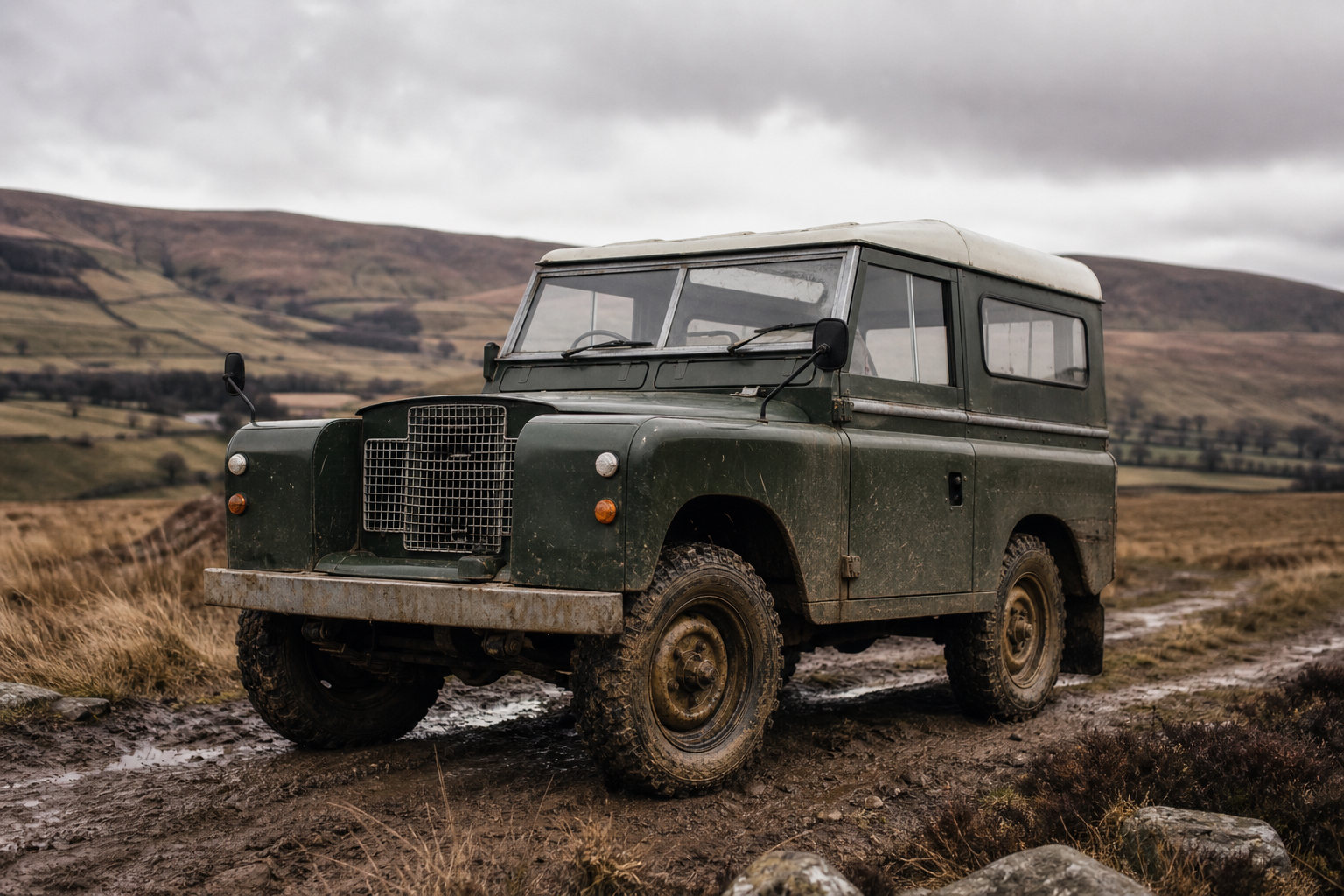
Maurice Wilks drew the first Land Rover in the sand on Red Wharf Bay in 1947, sketching a simple, go-anywhere vehicle to work his farm. He can have had no idea that the shape would still be in production, barely changed in silhouette, more than seventy years later - or that the descendants of that farm tool would become appreciating collector assets fought over from Yorkshire to Milan.
That is the strange journey of the Land Rover: a vehicle designed to be useful, disposable, endlessly repairable, that instead became treasured. For the collector in 2026 there is an added twist. After a decade of relentless appreciation - particularly for the Defender, which became a fashion object as much as a vehicle - the market has cooled. The Carseto Classic Car Index shows values across almost the entire classic range easing over the last quarter. For a buyer, that is the most useful thing this guide can tell you: the fever has broken, and there are better deals now than there were two years ago.
This guide covers the Series cars and the Defender, with the Range Rover Classic and the first Discovery as the natural companions, all with current European pricing.
The Land Rover story: why a farm tool became an asset
The appeal is easy to understand and hard to fake. A classic Land Rover is honest in a way almost nothing else on the road is. Body-on-frame construction, aluminium alloy panels that do not rust, mechanical simplicity you can work on with hand tools, and a design so unhurried it was still recognisably the same vehicle in 2016 as in 1948. People do not buy them to be comfortable. They buy them because they are the real thing.
That authenticity is exactly why values climbed - and why the recent softening matters. When a car becomes fashionable, its price detaches from what the vehicle can do and attaches to what it signals. When fashion moves on, the price drifts back toward the vehicle. That is broadly what the Index is showing in 2026, and it favours the buyer who wants the Land Rover for the Land Rover.
For a wider read on this pattern across the market, the guide to classics under €30,000 with real appreciation potential sets the Series cars in context.
The Series Land Rovers (1948-1985): the originals
Browse Series and Defender listings across Europe.
From working Series III to Tdi Defenders in the UK, Italy, and Spain.
The Series I, II, and III are the purest expression of the idea. Simple, agricultural, and now genuinely old, they are bought by people who value originality and the working-vehicle character. The Index splits them cleanly by generation, and interestingly, they have held up better than the Defender through the recent cooling.
Series I (1948-1956). The founding cars, and the collector's blue-chip. The Index records a median of €18,671, ranging from about €8,900 to €41,350 (CCI, July 2026) - but note this is also the band that has moved most, down 38.3% over three months across 97 observations. A drop that steep in a small, high-value dataset should be read carefully: it reflects a genuine cooling in the top of the Series market rather than a collapse, and it means the early cars that were untouchable at the peak are now more reachable. Originality and provenance are everything here. A matching, documented Series I is a different asset from a rebuilt one.
Series II and IIA (1958-1971). The volume-production cars that took Land Rover global. The Index puts them at a median of €16,702, from about €7,550 to €31,770 (CCI, July 2026), down 19.7% over the quarter across 159 observations. These are the sweet spot for many buyers: old enough to be a genuine classic, common enough to be well supported, characterful without the Series I premium.
Series III (1971-1985). The most numerous and the most usable, with the plastic grille and synchromesh gearbox that make them the easiest Series car to live with. The Index records a median of €18,892, from about €10,300 to €37,610 (CCI, July 2026) - and, tellingly, it is the most stable of the three, down just 7.5% over three months across 291 observations, the largest and most reliable Series dataset. If you want a Series Land Rover to actually use, the III is where the value and the sanity meet.
There are around 272 Series Land Rovers live on Carseto right now (July 2026). You can see the current spread on the Land Rover model hub.
The Defender (1983-2016): the icon that got expensive, then didn't
The Defender name arrived in 1990, but the vehicle - the coil-sprung, One Ten and Ninety development of the Series - dates from 1983. The Index treats the whole 1983-2007 run as one generation, and it is by far the deepest dataset in this guide.
Defender, 1983-2007. The classic coil-sprung Defender in its Tdi and Td5 forms is the collector's default. The Index puts it at a median of €25,307, ranging from about €13,900 to €49,800 (CCI, July 2026), drawn from a very robust 817 observations - but down 22.2% over three months. That is the single clearest number in this guide. The Defender was the poster child of the classic-4x4 boom, and it is the poster child of the correction. A median down more than a fifth in a quarter is not a car in trouble; it is a car that got ahead of itself and is coming back to earth. For a buyer who wants a usable, iconic Defender rather than a speculative one, this is a materially better market than 2024.
Defender, 2007-2016 (Puma). The final, most modern Defenders - the 2.4 and 2.2 Puma-engined cars with the more civilised interior - sit higher, at a median of €33,404, from about €21,350 to €60,500 (CCI, July 2026). These are the newest classics, and their values reflect it. The observation count is smaller (43), so treat the figure as directional.
A word on the modern Defender: the 2020-onward L663 is a different vehicle entirely, and while the Index tracks it, it is not a classic - it is a used car. Do not confuse the two markets.
Across Europe there are around 811 Defenders live on Carseto today (July 2026) - and, unsurprisingly for a British icon, the UK holds the largest share.
The Range Rover Classic and the first Discovery: the companions
Two more Land Rovers belong in any serious buyer's thinking.
Range Rover Classic (1970-1996). The original luxury 4x4, and increasingly collectible in its own right, especially the early two-door and "Suffix A" cars. The Index records a median of €19,200, from about €8,360 to €43,900 (CCI, July 2026), down 21.7% over the quarter across 315 observations - the same cooling as the Defender. The two-door early cars and the CSK sit well above the median; a tired four-door 3.9 sits well below it. The following P38 generation (1994-2002) is a cheaper and more troublesome proposition, at a median of just €9,904 (CCI, July 2026) and falling faster (-37.7%) - a car for the brave.
Discovery 1 (1989-1998). Here is the one riser in the whole Land Rover range. The first Discovery, built on Range Rover Classic underpinnings, records a median of €12,430 (CCI, July 2026) and - alone among the classic Land Rovers - a positive three-month trend of +4.5%. It is the value entry point into classic Land Rover ownership and, quietly, the model the market is warming to while everything else cools. Worth watching.
The three-point inspection: chassis, chassis, chassis
Anchor any asking price to the market.
See how Series and Defender values trend - and spot a restomod premium.
Land Rovers do not rust where you look; they rust where you do not. The aluminium panels survive almost anything, which lulls buyers into a false sense of security while the steel underneath dissolves. Almost every bad Land Rover purchase comes down to structure. Three points decide it.
1. The chassis. This is the whole game. On Series cars and Defenders alike, the steel chassis rots from the inside out, particularly at the rear cross-member, the spring hangers, the outriggers, and around the fuel tank. Prod it, do not just look at it. Fresh underseal is a warning sign, not a reassurance. A galvanised replacement chassis is common and acceptable - but it must be documented, and a car with a fresh galvanised chassis and paperwork is worth a premium over one with an original, rotten one.
2. The bulkhead. The steel bulkhead behind the engine is the most expensive rust repair on a Series or Defender. Check the footwells, the door pillars, and the top rail where the windscreen sits. A rotten bulkhead is a very costly job, and a common reason a cheap Land Rover is cheap.
3. The outriggers and floors. The small structural outriggers that support the body and the floor sections are frequent failure points. Lift the mats and the seat bases and look.
The principle: a Land Rover's real condition lives underneath. A shiny repaint means nothing if the chassis is soft. This is precisely the kind of car where a documented history - every chassis change, every major repair, logged - translates directly into resale value. That is what the Garage is for.
The fakes, the re-chassis cars, and the restomod effect
The Land Rover market has two specific traps that other classics do not.
Re-chassis and "identity" cars. Because chassis and bulkheads are replaceable, and because a good registration is valuable, some cars on the market are Frankenstein builds - a new chassis, a different body, a donor registration - sold as something older or more original than they are. This matters most at the top of the Series I and early Defender market, where originality commands a premium. Verify the chassis number against the registration and the paperwork. If the story does not add up, walk away. This is one area where buying through documented, traceable listings genuinely protects you.
The restomod effect. Companies like Twisted and Arkonik take Defenders and rebuild them to a very high standard with modern drivetrains and luxury interiors, selling at multiples of a standard car's value. This is a legitimate and desirable niche - but it distorts the picture for ordinary buyers. A "restored Defender" advertised at a restomod-adjacent price is not the same thing as a professionally re-engineered one, and the Index median is the reality check. Use the Carseto Index to anchor any asking price against the actual market.
Where to buy across Europe
The Land Rover is a British icon, and the UK is the deepest market - but it is far from the only one, and post-Brexit the picture has changed.
- United Kingdom (811 listings) is the natural home: the widest choice, the deepest specialist and parts network, and the most knowledgeable sellers. For EU buyers, though, importing from the UK now carries customs and registration steps worth understanding before you commit.
- Italy (568 listings) is a genuine surprise and the second-deepest market - Land Rovers have a devoted Italian following, and there is real value here.
- France (254), Spain (206), and the Netherlands (205) all offer strong choice, with Spain in particular worth watching for dry-climate Series cars with less structural rot.
- Germany (142), Poland (131), and Belgium (101) round out the picture.
For UK cars bought from the Continent - or Continental cars bought from Britain - the mechanics of moving a classic across the Channel matter. The existing guide on importing a classic between Germany and the UK covers the process, and a dedicated UK-to-EU guide is on the way. You can start from the United Kingdom browse page to see current British stock.
Classic Land Rover insurance is straightforward and well served by agreed-value specialists - see the country-by-country insurance guide for how cover works in each market. And when you buy, the Garage is where the chassis history and provenance that protect your resale value get recorded.
The verdict
Track your classic in My Garage.
Log every chassis change and major repair - documented history protects resale value.
The classic Land Rover market in 2026 is defined by one word: correction. After a decade in which the Defender in particular became a fashion object, values across almost the entire classic range have eased - the Defender down more than a fifth, the Series I down nearly 40%, the Range Rover Classic down over a fifth (all CCI, July 2026). The stable exceptions - the Series III, down only 7.5%, and the first Discovery, actually up - tell you where the sensible value sits.
For a buyer, none of this is bad news. A cooling market rewards the person who wanted the vehicle rather than the trend. Learn to read the chassis, verify the identity, favour the documented car, and a classic Land Rover will do what it has always done: keep going, keep working, and keep its value better than almost anything else with a ladder frame.
Frequently asked questions
How much does a classic Land Rover Defender cost in 2026? The classic coil-sprung Defender (1983-2007) sits at a median of around €25,300 on the Carseto Index (July 2026), ranging from about €13,900 for a rougher example to €49,800 for the best. The later Puma-engined Defenders (2007-2016) are higher, at a median of around €33,400.
How much is a Land Rover Series worth? On the Carseto Index (July 2026), the Series I (1948-1956) sits at a median of around €18,700, the Series II and IIA (1958-1971) at around €16,700, and the Series III (1971-1985) at around €18,900. Condition, originality, and a sound chassis move these figures substantially.
Are classic Land Rover values rising or falling? Most of the range softened over the last quarter - the classic Defender down about 22%, the Series I down nearly 40%, and the Range Rover Classic down about 22% (all CCI, July 2026). The Series III (down only 7.5%) and the first Discovery (up around 4.5%) are the exceptions. For buyers, the cooling market is favourable.
What is the most important thing to check when buying a Land Rover? The chassis. On both Series cars and Defenders, the steel chassis rots at the rear cross-member, spring hangers, and outriggers. Prod it rather than just looking, and be suspicious of fresh underseal. A documented galvanised replacement chassis is acceptable and often desirable; original rot is a major cost.
What is a "re-chassis" Land Rover and why does it matter? Because chassis, bulkheads, and bodies are all replaceable, some cars are built from mixed parts around a valuable registration and sold as more original or older than they are. Verify the chassis number against the paperwork. This matters most for high-value Series I and early Defender cars where originality commands a premium.
Is a restored Defender the same as a Twisted or Arkonik restomod? No. Restomod specialists like Twisted and Arkonik professionally re-engineer Defenders and sell at a large premium. A standard "restored" Defender advertised near restomod money is not the same thing. Use the Carseto Index median as a reality check on any asking price.
Where in Europe is the best place to buy a classic Land Rover? The UK is the deepest market with the best specialist support, but Italy is a strong and sometimes better-value second, and Spain is worth watching for dry-climate Series cars with less structural rust. Carseto lets you compare across all markets in one search; for UK cars, factor in post-Brexit import steps.
Prices in this guide are drawn from the Carseto Classic Car Index and were current as of July 2026. Values move; check the live Carseto Index before making an offer. Listing counts were accurate at the time of writing and change daily.
This article is part of the Carseto Journal - market intelligence and stories from Europe's classic car world.