For forty years these were the cars that moved half a continent. Overlooked in the West and only now being taken seriously as classics, the people's cars of the East are among the last genuine bargains - and, quietly, some of the fastest-rising values on the market. Here is what they cost, what to check, and why they are so hard to find.
Every collector market has its overlooked corner, the one the big money has not yet reached. In Europe in 2026, that corner is unmistakably the East. The FSO Polonez, the Trabant, the Lada, the Warszawa - the cars that carried Poland, East Germany, and the Soviet bloc through four decades - spent thirty years being the butt of jokes. They are not being laughed at any more. A generation that grew up with these cars, in Poland and in the former East Germany, has reached the age and the means to want them back, and the values are beginning to move accordingly.
This is a guide to that market - honestly, including its awkward parts. These are cheap cars, thinly traded, and the data behind their prices is thinner than for a Porsche or a Mercedes. Where the numbers are solid, we will give them. Where they are not, we will say so. What is not in doubt is the direction: the two best-documented cars in this guide, the little Fiat 126 and the Trabant 601, are among the strongest risers of any classic tracked by the Carseto Index. The joke has become an investment.
The people's cars of the East
To understand these cars you have to understand what they were for. They were not built to delight. They were built to democratise the automobile in economies that could not afford to do it the Western way - to put a family on four wheels using the least steel, the simplest engineering, and the most forgiving mechanicals possible. Judged as consumer products in a free market, they were mediocre. Judged as solutions to an almost impossible brief, they were small miracles.
That is precisely why they now inspire such affection. A Trabant is not admired the way a Jaguar is admired; it is loved, the way you love something that got a whole country through hard years. This emotional weight is the entire basis of their rising value, and it is worth reading the companion essay on the psychology of why we collect to understand why cars like these can matter more to their owners than machines worth fifty times as much.
A practical note before the models: this is a Polish and Central European market above all. Of the classic Eastern Bloc cars currently listed on Carseto, the overwhelming majority are in Poland, with only a handful scattered across Germany, France, and Britain. These cars rarely surface on the open pan-European market, and when they do they are hard to find because they sit on national Polish and German sites that a Western collector never sees. Bringing that scattered market into one searchable place is exactly the problem Carseto exists to solve.
The FSO Polonez: Poland's own car
Browse FSO Polonez and Warszawa listings on Carseto.
The deepest Eastern Bloc stock sits in Poland - see what's listed now.
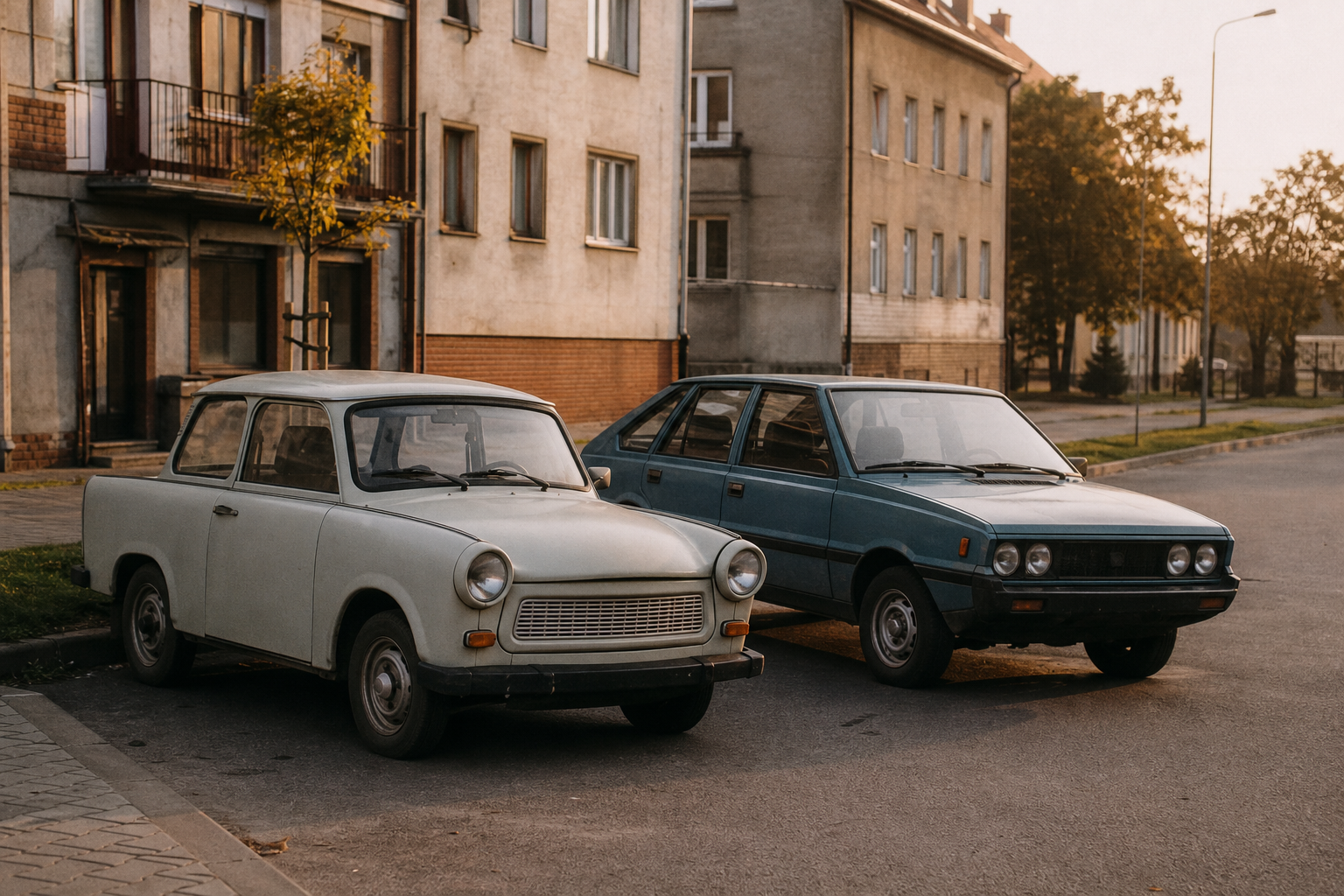
If one car represents Poland's motor industry, it is the Polonez. Built in Warsaw from 1978 until 2002 - an astonishing production run - it was the car Poland designed largely for itself, evolving from the earlier Polski Fiat licence into something genuinely national. The angular Giugiaro-influenced hatchback body housed simple, rugged mechanicals, and for a quarter of a century it was everywhere on Polish roads: family car, taxi, police car, workhorse.
For collectors, the Polonez market is young and affordable. The Carseto Index puts the first-generation Polonez (1978-1986) at a median of around €5,639 (CCI, July 2026), and the restyled version (1986-1992) at around €5,469 (CCI, July 2026), with the later Caro-era cars (1991-2002) similar or slightly lower. A word of honesty on these figures: they rest on small numbers of observations - single figures to low teens - so treat them as a reasonable guide to the level rather than a precise valuation. The market is too thin for precision. What they tell you clearly enough is that a good, honest Polonez is still a three-to-seven-thousand-euro car, which for a piece of national history is remarkable value.
The grandfather of the FSO line is worth knowing too. The Warszawa (1964-1973), the big, upright saloon that preceded the Polonez, is the priciest FSO in the guide, at a median of around €10,872 (CCI, July 2026) - older, rarer, and increasingly sought as a genuine period piece.
You can see the current FSO stock on the FSO model hub, and browse the wider Polish market on the Poland browse page.
The Trabant: the Duroplast icon
No car carries more symbolic weight than the Trabant. The little East German two-stroke, its body famously moulded from Duroplast - a cotton-and-resin composite that will not rust but will, in the old joke, be eaten by goats - became the accidental symbol of the fall of the Berlin Wall, streaming west through the checkpoints in 1989. That image did more for the Trabant's long-term collectibility than any road test ever could.
The core car is the Trabant P601, built with little change from 1963 to 1990. The Carseto Index records a median of around €5,483, ranging from about €3,558 to €8,925 (CCI, July 2026) - and, more interestingly, a three-month trend of +38.9%. That is one of the strongest upward moves of any classic the Index tracks. The observation count is small (around a dozen), so the precise percentage should be read with caution, but the direction is unmistakable and it matches everything happening in the wider market: the Trabant is being reappraised, fast. The final Trabant 1.1 (1990-1991), fitted with a VW-derived four-stroke engine as the Wall came down, is rarer and sits a little higher, though on very few data points.
The Trabant's appeal is its combination of historical significance and mechanical simplicity. The two-stroke engine has almost no parts to go wrong, the Duroplast body does not rot, and a strong German and Czech club scene keeps the cars running. What it asks of an owner is tolerance - of the smoke, the noise, and the leisurely pace. Current Trabant listings are on the Trabant model hub.
The Lada: the Fiat that outlived its parent
The Lada story is one of the great ironies of motoring. In 1970 the Soviet Union began building a licensed copy of the Fiat 124 at Tolyatti; the Fiat 124 was discontinued in Italy a few years later, but the Lada version - the 2101 "Kopeck" and its many descendants - carried on, in one form or another, for over four decades. Add the legendary Niva, the compact 4x4 that became a cult object in its own right, and Lada has a genuine collector following.
Here honesty requires a clear statement: the Carseto Index does not yet publish a computed value for classic Ladas. There are too few in the aggregated data to produce a figure we would stand behind, and inventing one would be worse than useless. What can be said is that the classic Lada saloons remain among the most affordable classics in Europe, typically trading in the low thousands, while the Niva commands a premium that has been climbing as interest in characterful small 4x4s grows across the market. If you are buying a Lada, the Carseto Index is the place to check whether a figure has been published for your specific model by the time you read this - the data deepens continually as more cars are listed.
The rising-interest thesis: why now
Put the pieces together and a clear pattern emerges. The two Eastern Bloc classics with enough data to track a trend - the Fiat 126 and the Trabant 601 - are both rising sharply, the little Fiat up around 45% and the Trabant up nearly 39% over three months (both CCI, July 2026). That is not noise. It is the leading edge of a nostalgia wave that the classic market has seen before with other cars, and it has a clear demographic engine.
The people who grew up with these cars - in Poland, in the former East Germany, across Central Europe - are now in their forties, fifties, and sixties: the classic-buying years. They are buying back the cars of their childhoods, exactly as their Western contemporaries did a generation earlier with Escorts and Beetles. And because these cars start from such a low base and were never taken seriously as collectibles, there is a great deal of room for values to climb before they look expensive. The Fiat 126p Maluch - covered in depth in our Polish-language guide - is the clearest example of this wave already in motion.
None of this is a promise of returns, and nobody should buy a Trabant as an investment. But it does mean that buying one of these cars now, for the love of it, is unlikely to be a financial mistake, and might quietly turn out to be a shrewd one.
What to check across all three
The good news is that these are among the simplest cars ever mass-produced, and inspecting one requires no special expertise. Three principles cover almost everything.
Rust, except on the Trabant. The FSO Polonez, the Warszawa, and the Lada are all steel-bodied and rust in the usual places: sills, floors, wheel arches, and around the suspension mounts. Communist-era steel and paint were not the best, so inspect thoroughly. The Trabant is the happy exception - its Duroplast body does not corrode - but check the steel frame underneath the Duroplast, which very much does.
Simple mechanicals, cheap to fix. The engines and running gear on all of these are elementary and forgiving. Parts are inexpensive and, in Poland and Germany especially, still available through active club networks and specialist suppliers. A mechanically tired example is rarely a deal-breaker; the work is cheap and simple. This is the opposite of a Citroën DS, where the complexity is the risk. Here, the risk is rot and completeness, not mechanical sophistication.
Completeness and originality. Because these were cheap, disposable cars, many were used up and scrapped, and trim, badges, and interior parts can be very hard to find even though mechanical parts are easy. A complete, original car is worth a clear premium over one missing its correct fittings. This is where documentation matters: a car whose history, originality, and parts are recorded is worth more, and the Garage is the natural place to keep that record - especially for cars this affordable, where provenance and story do more of the work of value than the spec sheet ever could.
Living with an Eastern Bloc classic
These are, in the best sense, undemanding classics. Running costs are minimal, insurance is cheap, and the mechanical simplicity means many owners do all their own work. The club scene in Poland, Germany, and the Czech Republic is warm, knowledgeable, and welcoming to newcomers - part of the pleasure of owning one of these cars is joining a community that remembers exactly what they meant.
What you trade for that is performance, refinement, and, occasionally, availability of the more obscure trim parts. Nobody buys a Polonez or a Trabant to go fast or to travel in comfort. You buy one because it is honest, because it is cheap, because it makes people smile, and - increasingly - because it is a piece of European history that the rest of the market has not yet fully noticed.
Where to find them
The Polish market is where these cars live.
Browse the deepest pool of Eastern Bloc classics in one place.
This is the hard part, and the reason a pan-European search matters most for exactly these cars. The Eastern Bloc classic market lives overwhelmingly in Poland, with the German-market cars (Trabant especially) concentrated in the former East. On the open pan-European listings, these cars are scarce - a few dozen at any given time across all makes combined - and scattered across national sites in Polish and German that a Western collector would never think to search.
That scarcity is not a reason to give up; it is a reason to search widely and patiently, and to set an alert. The Poland browse page is the single best starting point, since that is where the depth is. When you find the right car, the Garage is where its next chapter begins - and for a car this overlooked, a well-documented example is quietly building the provenance that the rising market will increasingly reward.
The verdict
Document your classic in My Garage.
For an overlooked car, a well-kept record builds the provenance the market rewards.
The people's cars of the East are the last uncontested corner of the European classic market, and they are not going to stay uncontested for long. The Fiat 126 and the Trabant 601 are already climbing fast; the Polonez and the Warszawa remain remarkable value for genuine pieces of national history; the Lada waits quietly for the data to catch up with the affection. Prices start in the low thousands and rarely trouble five figures.
Buy one for the right reasons - because it means something, because it makes you smile, because it is honest in a way modern cars cannot be - and the recent movement in values suggests you will not regret it. Just be prepared to search hard: the greatest difficulty with these cars is not affording them, but finding them.
Frequently asked questions
How much does an FSO Polonez cost in 2026? On the Carseto Index (July 2026), a first-generation Polonez (1978-1986) sits at a median of around €5,639 and the restyled 1986-1992 cars at around €5,469, with a good honest example generally between roughly €3,500 and €8,000. These figures rest on a small number of observations, so treat them as a guide to the level rather than a precise valuation.
How much is a Trabant worth now? The Trabant P601 (1963-1990) has a median of around €5,483 on the Carseto Index (July 2026), ranging from about €3,558 to €8,925. Notably, it is one of the fastest-rising classics the Index tracks, up nearly 39% over three months, though on a small dataset.
Are Eastern Bloc classic cars a good investment? Nobody should buy one purely as an investment, but the trend is clearly upward. The two best-documented cars in this segment - the Fiat 126 and the Trabant 601 - are both rising sharply (around 45% and 39% respectively over three months, CCI July 2026), driven by a generation buying back the cars of their youth. Buying now for the love of it is unlikely to prove a financial mistake.
What should I check when buying a Trabant? The Duroplast body does not rust, which is the Trabant's great advantage - but the steel frame underneath it does, so inspect that carefully. The two-stroke engine is extremely simple and cheap to fix. Completeness and correct trim matter most, as small parts can be hard to source.
Why are Eastern Bloc classics so hard to find? They live overwhelmingly in Poland, with German-market Trabants concentrated in the former East. Only a few dozen are listed across the open pan-European market at any time, scattered across national Polish and German sites. This is precisely why a pan-European search and a saved alert are so useful for these cars.
Where is the best place to buy an FSO, Trabant, or Lada? Poland is by far the deepest market, and the natural starting point. Germany and the Czech Republic are the next best, especially for Trabants. Because supply is thin, patience and a saved search matter more here than for any mainstream classic.
Prices in this guide are drawn from the Carseto Classic Car Index and were current as of July 2026. This is a thinly traded segment, so figures rest on small samples and should be read as directional. Check the live Carseto Index before making an offer.
This article is part of the Carseto Journal - market intelligence and stories from Europe's classic car world.