Two cars, one company, and a shared belief that a car should do something no other car does. Here is what the DS and the 2CV cost across Europe in 2026, what decides a good one from a bad one, and where to find the examples worth owning.
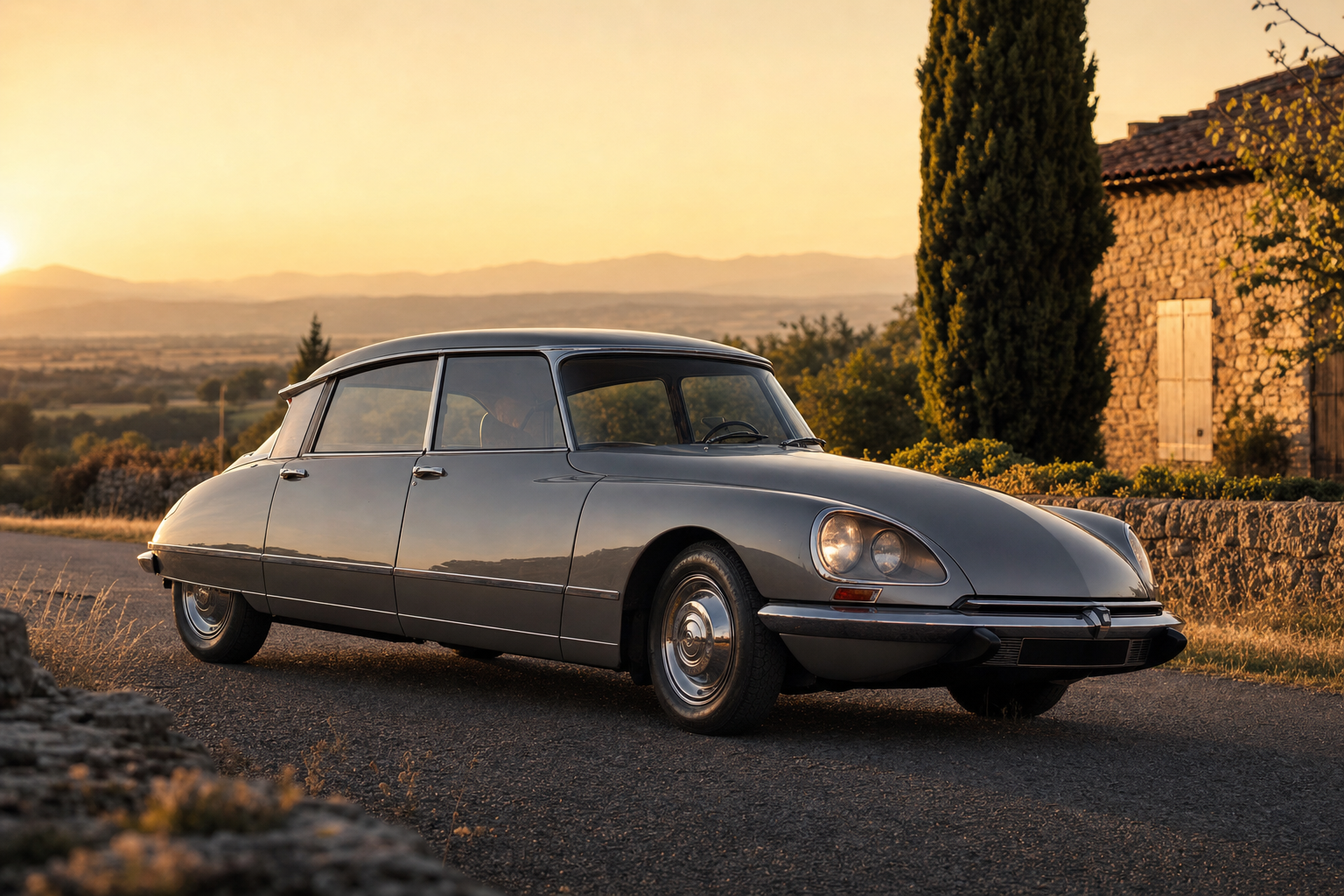
No other manufacturer has bracketed the automobile quite the way Citroën did. At one end, the DS - a car that looked like it had landed rather than been built, gliding on hydropneumatic suspension that most of the industry would not attempt for another thirty years. At the other, the 2CV - an umbrella on wheels, designed to carry two farmers and a basket of eggs across a ploughed field without breaking a single shell. They could not be more different. And yet they share a bloodline: the conviction that engineering should serve an idea, not the other way round.
For a collector, that shared philosophy is also a practical gift. Both cars are simple to understand, well supported by parts and clubs, and - after a cooling first half of 2026 - more affordable than they have been in several years. This guide covers both, model by model, with current European pricing from the Carseto Classic Car Index, the two inspection points that decide almost every purchase, and an honest read on where the market sits now.
Why the DS and 2CV belong in the same guide
It is tempting to treat these as separate worlds - the DS as the design-icon investment, the 2CV as the cheap-and-cheerful runabout. In practice, buyers cross between them constantly. Someone drawn to the DS for its presence often ends up with a 2CV for weekend use because it is so much easier to live with. Someone who bought a 2CV as a first classic frequently graduates to a DS once the confidence is there.
They also share the two things every Citroën buyer must learn to read: the hydraulics and the rust. Get those right and both cars are genuinely usable classics. Get them wrong and either can become a slow financial leak. We will come back to both in detail.
If you are buying your first classic of any make, the companion piece on what to check, budget, and the mistakes every beginner makes is worth reading alongside this one.
The Citroën DS: the car that arrived from the future
Browse Citroën DS and 2CV listings across Europe.
From project 2CVs to concours DS - the whole market in one search.
When the DS was unveiled at the 1955 Paris Motor Show, Citroën took 12,000 orders on the first day. The reason is still visible sixty years later. The self-levelling hydropneumatic suspension, the semi-automatic gearbox, the front disc brakes, the aerodynamic shape drawn by Flaminio Bertoni - nothing else on the road came close. It stayed in production until 1975, and across those twenty years it evolved from the original DS19 through to the DS23, with the more basic ID models sitting beneath.
For buyers, the DS market splits into three broad bands, and the Carseto Index shows them clearly.
Early DS (1955-1963). The original cars, with the distinctive round-nose front and the earliest hydraulics, are the purist's choice. They are also rare, and priced accordingly: the Index puts this generation at a median of €28,626, ranging from about €12,600 to €33,800 (CCI, July 2026), though the observation count here is modest, so treat it as directional rather than precise. These are cars bought with the head as much as the heart - condition and originality matter enormously.
The restyled DS (1962-1967). The mid-life cars, still round-nosed but mechanically matured, currently sit at a median of €27,625, from roughly €12,750 to €49,300 (CCI, July 2026). This is also the band that has moved most in the recent market: the Index records a three-month trend of -27.7% (CCI, July 2026), a meaningful softening. For a buyer, that is not a warning - it is an opening. A car whose value has eased by a quarter is a car bought at a better moment than eighteen months ago.
The later DS (1967-1976). The final cars, with the aerodynamic covered headlamps that most people picture when they hear "DS", are both the most usable and the most available. The Index puts this generation at a median of €13,495, from about €6,925 to €22,995 (CCI, July 2026) - and, tellingly, it is the most stable of the three, with a three-month trend of just +1.7% (CCI, July 2026) across 265 observations. If you want a DS to drive rather than to preserve, this is the value sweet spot.
Two related cars are worth knowing. The SM, the DS's grand-touring cousin with a Maserati V6, is a different financial proposition entirely - the Index records a median of €42,075, from €17,000 to €55,250 (CCI, July 2026), stable over the quarter. And the pre-war-rooted Traction Avant, the car that established Citroën's front-wheel-drive template, sits far lower at a median of €8,890 (CCI, July 2026), easing gently (-5.8% over three months). All three trace to the same engineering courage.
Across Europe there are around 253 classic DS listed on Carseto right now (July 2026), the largest concentration in France. You can see the current spread on the Citroën model hub.
The Citroën 2CV: the people's car that refused to die
If the DS was Citroën reaching for the future, the 2CV was Citroën solving the present. Conceived before the war to motorise rural France, it entered production in 1948 and did not leave until 1990 - forty-two years, largely unchanged in spirit. It is one of the most quietly brilliant cars ever made: air-cooled twin, interconnected suspension that soaks up a rutted field, canvas roof, and a cabin you can hose out.
For collectors, the good news is that the 2CV is abundant, cheap to run, and superbly supported. The recent news is that prices have come down. The Index tells a consistent story across the generations:
The final 2CV (1979-1991). The most numerous and the easiest to find, these are the cars most people buy. The Index puts them at a median of €11,730, from about €7,650 to €19,465 (CCI, July 2026), with a three-month trend of -14.3% across 339 observations - the deepest and most reliable dataset of any 2CV generation. A double-digit softening in the most-traded band is the clearest signal in this guide that 2026 is a buyer's year.
The mid-life 2CV (1975-1979). A median of €10,625 (CCI, July 2026), down 12.3% over the quarter - the same cooling trend.
The earlier 2CV (1966-1975). Interestingly, the most stable band: a median of €10,200 (CCI, July 2026) and essentially flat over three months. Older 2CVs, closer to the original design, are holding their value while the later cars ease.
Two 2CV relatives deserve a mention. The Dyane, the slightly more modern-bodied sibling, is cheaper still at a median of €8,330 (CCI, July 2026). And the Méhari, the plastic-bodied beach car built on 2CV mechanicals, is the priciest of the family at a median of €18,615 (CCI, July 2026) - though it too has softened sharply, down 22.4% over three months, which brings a cult car within closer reach than it has been.
There are roughly 421 classic 2CVs live on Carseto today (July 2026), again concentrated in France but with strong pockets in the Netherlands, Belgium, and Italy.
For a wider view of what an appreciating classic looks like in this price band, the guide to classics under €30,000 with genuine upside sets the DS and 2CV in context against the rest of the market.
The two things that decide every Citroën purchase
See how DS and 2CV values trend over time.
Sanity-check any asking price against the market median before you travel.
1. The hydraulics
This applies mainly to the DS (and SM), not the 2CV, whose suspension is purely mechanical. The DS's hydropneumatic system runs the suspension, the brakes, the steering, and the gearchange from a single high-pressure circuit. When it works, it is sublime. When it has been neglected, it is the single largest source of cost and anxiety in DS ownership.
What to check: with the engine running, the car should rise smoothly to full height within a minute, sit level, and stay there. Watch for weeping at the spheres, hardened or perished hoses, and a green LHM fluid that should be clean, not dark. A car that rises slowly, sits unevenly, or drops overnight is telling you it needs work - not necessarily a deal-breaker, but a number to factor into the price. A full hydraulic refresh is not cheap, and a seller who cannot demonstrate the system working properly is a seller you negotiate hard with.
The good news: a properly maintained system is reliable and the components are all available. The system is not fragile - it is simply unforgiving of neglect. Buy a DS whose owner understood that, and you avoid the trap.
2. The rust
This applies to both cars, and it is where the money is won or lost. Neither car was galvanised from the factory, and both hide their structure beneath panels.
On the DS, inspect the box sections beneath the floor, the front subframe mounting points, the sills, and the bottoms of the doors. The DS's non-structural outer panels bolt on, which is a blessing for repair but can also disguise a rotten shell beneath tidy-looking bodywork. Lift the mats, look underneath, and be suspicious of fresh underseal.
On the 2CV, the chassis is the whole game. The separate chassis rusts, and a rotten one is an MOT and safety failure. The good news is that new galvanised chassis are available and not expensive - but fitting one is a full rebuild, so a car sold with a fresh galvanised chassis and paperwork to prove it is worth a premium, while a car with original rot is a project priced accordingly. Also check the floors, the boot floor, and the A-pillars.
The principle for both: a documented, honest car - even a slightly scruffy one - beats a shiny car with an unknown history. This is exactly why the Garage exists as a documentation tool: provenance and a maintenance record are worth real money at resale, and the cars that hold value are the ones whose stories are written down.
Living with a Citroën: parts, clubs, and running costs
Both cars are cheap to run by classic standards. The 2CV in particular is almost comically economical - a simple air-cooled twin, brakes and suspension anyone can learn, and a global parts network built over four decades. The DS is more involved because of the hydraulics, but even there the specialist and club support across France, the Netherlands, Belgium, and Germany is deep and knowledgeable.
Insurance is straightforward on both, and both are ideal candidates for agreed-value classic policies given their well-established markets. The country-by-country guide to classic car insurance in Europe covers how agreed value and limited-mileage cover work in each market.
Where to buy across Europe
This is where a pan-European view earns its keep. The Citroën market is heavily French - of the roughly 2,668 Citroëns currently on Carseto, 1,371 are in France (July 2026) - but the best value is not always at home.
- France (1,371 listings) is the deepest market and the natural home for both cars. The widest choice, the most specialists, and the strongest club scene. Start here: the France browse page shows the current spread.
- Italy (289) and the Netherlands (267) are the next-deepest markets, both with strong 2CV and DS followings.
- Germany (175) brings the usual German advantage: fastidiously maintained cars with thorough documentation, often at a small premium.
- Belgium (144), the UK (159), Poland (98), and Spain (61) round out the picture, each with occasional value to be found.
Because prices have softened across most of the range in the first half of 2026, this is a market where patience pays. You can compare a French 2CV against a Dutch or Belgian one in a single search, and the Carseto Index lets you sanity-check any asking price against the market median before you travel.
When you find the one, the Garage is where you start its next chapter - logging the hydraulic service history on a DS, or the galvanised-chassis paperwork on a 2CV, so that the car you eventually sell is worth more for being documented.
The verdict
Track your classic in My Garage.
Log the hydraulic service history or galvanised-chassis paperwork that protects resale value.
The DS and the 2CV are two answers to the same question: what should a car be? One answered with technology, the other with honesty, and both answers have aged beautifully. For 2026, the practical picture is clear. Prices across most of the range have eased - the mainstream 2CV down around 14%, the restyled DS down nearly 28%, the Méhari down over 22% (all CCI, July 2026) - which makes this a better moment to buy than the market has offered in some time. The stable exceptions, the later driving DS and the earliest 2CVs, tell you where the floor is.
Learn to read the hydraulics on a DS and the chassis on a 2CV, favour the documented car over the shiny one, and either of these will reward you for years. Few classics offer as much character for the money.
Frequently asked questions
How much does a Citroën DS cost in 2026? It depends heavily on the generation. The later, most usable DS (1967-1976) sits at a median of around €13,500 on the Carseto Index (July 2026), while the earlier and rarer cars run to a median of roughly €27,000-€29,000. The Maserati-engined SM is a separate market again, at around €42,000.
How much is a Citroën 2CV worth now? The final-generation 2CV (1979-1991) has a median of about €11,700 on the Carseto Index (July 2026), ranging from roughly €7,650 for a project to €19,500 for an excellent example. Earlier cars are broadly similar, and the Dyane sibling is a little cheaper.
Are Citroën DS and 2CV values rising or falling? Most of the range softened in the first half of 2026. The mainstream 2CV is down around 14% over three months, the restyled DS down nearly 28%, and the Méhari down over 22% (all CCI, July 2026). The later driving DS and the earliest 2CVs have held broadly stable. For buyers, the softening makes 2026 a favourable moment.
What is the most important thing to check when buying a DS? The hydropneumatic system. With the engine running, the car should rise smoothly, sit level, and stay there. Weeping spheres, perished hoses, or a car that drops overnight all point to work needed. A properly maintained system is reliable; a neglected one is the biggest cost in DS ownership.
What is the most important thing to check when buying a 2CV? The chassis. The separate chassis rusts, and a rotten one is a safety and MOT failure. A car with a fresh galvanised chassis and paperwork is worth a premium; original rot means a project. Also check floors, boot floor, and A-pillars.
Which is the better first classic - a DS or a 2CV? The 2CV is far easier to own as a first classic: simpler, cheaper, and more forgiving. The DS is more rewarding but demands that you understand its hydraulics. Many collectors start with a 2CV and move to a DS later.
Where in Europe is the best place to buy a classic Citroën? France is the deepest market by a wide margin and the natural home for both cars, but Italy, the Netherlands, and Germany all have strong followings - Germany especially for well-documented examples. Carseto lets you compare across all of them in one search.
Prices in this guide are drawn from the Carseto Classic Car Index and were current as of July 2026. Values move; check the live Carseto Index before making an offer. Listing counts were accurate at the time of writing and change daily.
This article is part of the Carseto Journal - market intelligence and stories from Europe's classic car world.