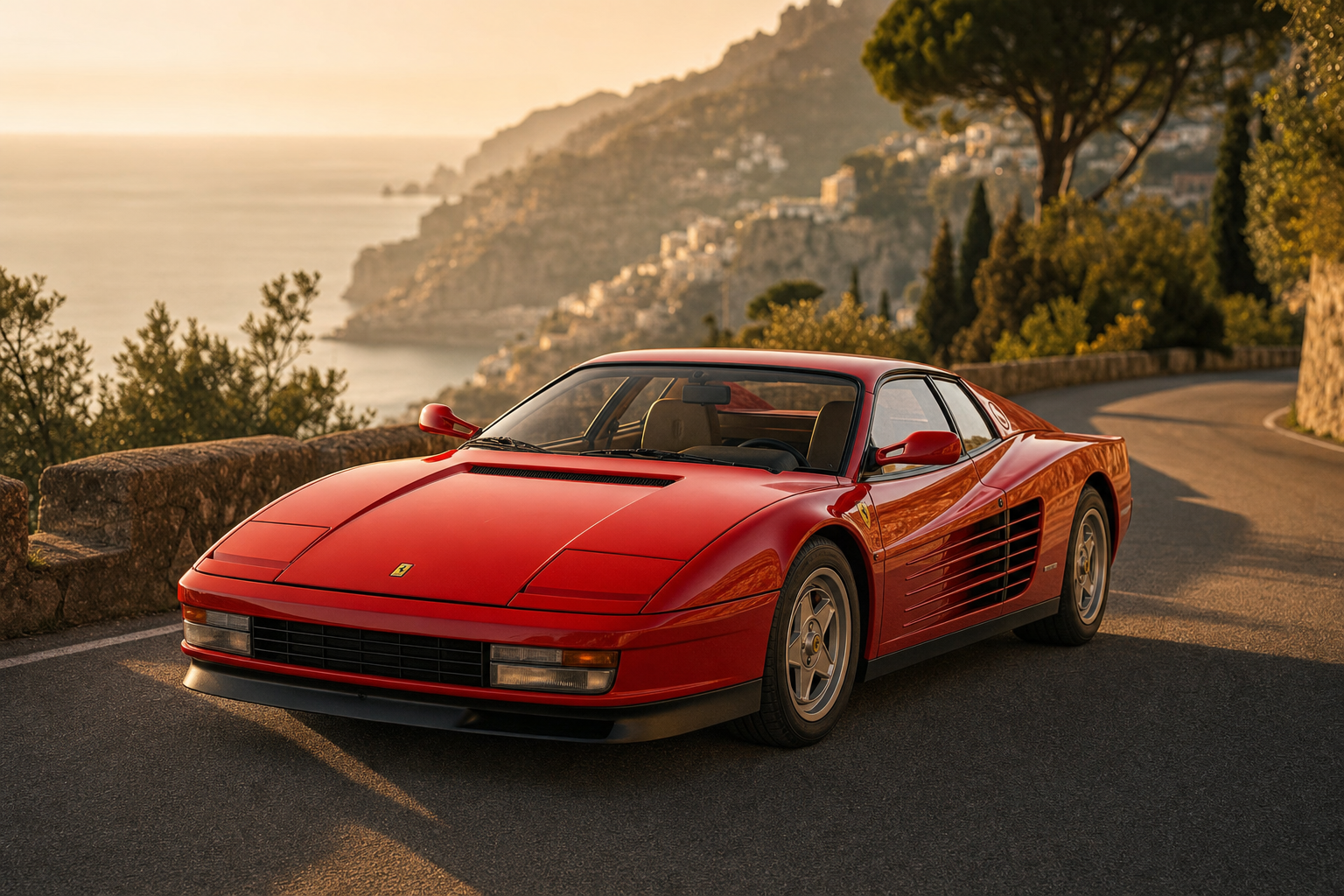
No car captures the 1980s more completely than the Ferrari Testarossa. The side strakes, the width, the flat-twelve engine singing at 6,000 rpm behind the cabin. It was the poster on every bedroom wall, the car in every episode of Miami Vice, and the machine that proved Ferrari could build a grand tourer with supercar performance. Pininfarina's design was controversial at launch: too wide, too angular, too much. Then it became the definitive supercar shape of its generation.
The Testarossa was produced from 1984 to 1996, evolving through three variants: the original Testarossa (1984–1991), the 512 TR (1992–1994), and the F512 M (1994–1996). Together, approximately 10,000 units were built, a generous number by Ferrari standards that makes the Testarossa significantly more accessible than many contemporary Ferraris.
In 2026, the Testarossa sits in a comfortable place. After a speculative run-up in 2015–2018 (when values briefly exceeded €300,000 for the best examples), prices corrected and have since stabilised. The car has transitioned from speculative asset to genuine collector car. Buyers today want to own and drive one, not chase financial returns. That shift means current pricing reflects real demand rather than manufactured scarcity.
Browse Ferrari Testarossa listings on Carseto →
The Three Variants
Browse Ferrari Testarossa listings across Europe on Carseto.
From original monospecchio Testarossas to 512 TR and F512 M examples in Italy, Germany, and the UK.
Testarossa (1984–1991)
The original. The flat-12 (tipo F113, 4,943cc) produces 390 hp and 361 Nm of torque, driving the rear wheels through a five-speed manual gearbox. The engine is a development of the Berlinetta Boxer's unit, dry-sumped, with four-valve heads, and a sound that sits somewhere between a turbine and a symphony orchestra.
Approximately 7,177 Testarossas were built. This is the most common variant and the most affordable, but "affordable" is relative: European prices sit at €120,000–€200,000 for good examples, with exceptional cars reaching €250,000.
Early Testarossas (1984–1986) have a single side mirror (driver's side only), which is period-correct but can disconcert modern drivers. The "monospecchio" (single-mirror) cars are slightly more sought-after by purists. From 1987, dual mirrors became standard across all markets.
512 TR (1992–1994)
The 512 TR, the Testarossa Rinnovata, refined every aspect of the original. Power rose to 428 hp, torque increased, and the chassis received revised suspension geometry, lighter wheels, and improved brakes. The body was subtly redesigned: lower nose, reshaped chin spoiler, and modified engine cover.
Approximately 2,261 512 TRs were built. The 512 TR is the driving enthusiast's choice: faster, more composed, and better-resolved than the original Testarossa, while retaining the flat-12 character and the Pininfarina silhouette. European prices: €150,000–€250,000.
F512 M (1994–1996)
The final evolution (M for Modificata). Power remained at 428 hp but with revised engine mapping. The most significant change was the adoption of fixed headlamps (replacing the original's retractable units), which modernised the car's face but divided opinion among collectors. Approximately 501 were built, making the F512 M the rarest and most valuable variant.
European prices: €250,000–€400,000+. The F512 M's rarity and "last of the line" status command a significant premium.
What to Look For
The Engine
The flat-12 is the Testarossa's greatest asset and its most significant maintenance consideration. When properly maintained, it is reliable and long-lived. When neglected, it is catastrophically expensive to rebuild.
The flat-12 has twin timing belts, one per bank. Service interval: every five years or 30,000 km (Ferrari's specification). A timing belt service requires engine removal, making it one of the most expensive routine services on any classic car: €3,000–€6,000 at a specialist, including belt, tensioners, and associated seals.
Verify the timing belt service history. If the belts have not been changed within the service interval, do not drive the car. Do not even start it. A snapped timing belt destroys the engine, and an engine rebuild costs €15,000–€30,000.
Some seepage from cam cover gaskets and the rear main seal is normal on high-mileage flat-12s. A steady drip is not. Check underneath after the car has been running for twenty minutes.
Blue smoke on start-up (valve guide wear) or under acceleration (ring wear) indicates engine work is needed. Ask for a compression test.
The Body
The Testarossa's body is a combination of steel (structure), aluminium (doors, engine cover, front boot lid), and composite (bumper covers). The steel sections can rust, particularly in the lower sills, rocker panels, and the area around the rear lights where moisture accumulates.
Aluminium panels do not rust but can corrode galvanically where they meet steel components. Check the door-to-sill junction, the bonnet hinge area, and the engine cover edges.
Panel fit on a Testarossa is not German-precise. Pininfarina's handbuilt construction means slight asymmetries are original, not evidence of accident damage. However, significant gaps or misalignment should be investigated.
The Interior
The Testarossa's cabin is leather-lined and beautifully finished in the Italian manner, which means it is lovely when maintained and deteriorates rapidly when neglected. UV damage to the dashboard (cracking), steering wheel (wear), and seat bolsters (sagging) is common on cars that have seen regular use.
Air conditioning: the original system uses R12 refrigerant, now banned. Conversion to R134a is standard but should have been done properly; a botched conversion can damage the compressor.
Running Costs
The Testarossa is not a cheap car to maintain. This should surprise nobody. But the costs are predictable and manageable if you understand them in advance.
Annual service (oil change, filter, basic inspection) at a Ferrari specialist: €1,000–€2,000.
Major service (timing belts, every five years): €3,000–€6,000. This is the single largest recurring cost.
Tyres: The Testarossa uses 240/45 VR415 on Michelin TRX metric wheels (original specification) or conventional sizes if the wheels have been converted. TRX tyres are expensive (€300–€500 per tyre) and increasingly scarce. Many owners have converted to standard-metric wheels and tyres, a modification that purists may not approve but that makes practical and financial sense.
Insurance: Agreed-value is essential. Annual premiums vary by market: €2,000–€5,000 in the UK, €1,500–€3,000 in Germany. Ferrari Classiche certification supports the agreed valuation.
The Market in 2026
See how Ferrari values trend over time.
Compare models and spot the best entry points for your budget.
The Testarossa market has stabilised after its 2015–2018 speculative peak. Current pricing reflects genuine collector demand rather than investment-driven speculation, making it a healthier and more predictable market to enter.
The strongest demand is for low-mileage, original-specification examples with documented Ferrari service history and, ideally, Classiche certification. Colour plays a role: Rosso Corsa (red) is the most sought-after, followed by Nero (black) and Bianco (white). Non-standard colours (yellow, blue, silver) trade at a modest discount unless they are original paint-to-sample specifications.
The 512 TR is increasingly recognised as the best driving Testarossa and is closing the price gap with the original. The F512 M, with its limited production, sits in a different market segment, closer to a collector piece than a driver's car.
Where to Buy
Italy is the natural home. Italian-market Testarossas benefit from climate-preserved bodies and access to the Ferrari specialist network centred on Maranello. Prices in Italy are typically 10–15% below UK equivalents.
Germany offers well-maintained examples with meticulous documentation. The UK has the deepest Ferrari specialist network outside Italy.
Ferrari Classiche certification is a significant value driver. Cars with Classiche Red Book certification, confirming original specification and matching numbers, command a 10–15% premium. If the car does not have certification, budget €3,000–€5,000 to apply.
Search Ferrari Testarossa listings across Europe on Carseto →
Frequently Asked Questions
Track your classic in My Garage.
Document your collection, get value insights, and list when you're ready to sell.
How much does a Ferrari Testarossa cost? Original Testarossa (1984–1991): €120,000–€250,000. 512 TR: €150,000–€250,000. F512 M: €250,000–€400,000+. Condition, mileage, service history, and Classiche certification are the primary price drivers.
Is the Ferrari Testarossa a good investment? The Testarossa is now a stable collector car rather than a speculative asset. Values are holding and gently appreciating for the best examples. Buy one for the driving experience and the ownership pleasure; expect it to hold its value rather than deliver rapid returns.
Is the Testarossa expensive to maintain? Yes. The timing belt service alone costs €3,000–€6,000 every five years. Annual running costs of €3,000–€8,000 (service, insurance, consumables) are realistic. The Testarossa rewards committed, informed ownership.
Which Testarossa is the best? For driving: the 512 TR. For collectibility: the F512 M. For value and the iconic 1980s experience: the original Testarossa.
The Poster Made Real
The Ferrari Testarossa lives up to the image. The flat-12 sound is as extraordinary as you imagined. The width is as dramatic as the photographs suggested. And the driving experience (the surge of mid-range torque, the mechanical directness of the unassisted steering, the theatre of a machine built in Maranello to be the fastest car in the world) is everything the fourteen-year-old version of you hoped it would be.
Start your search on Carseto →
Related reading: Porsche 911 Buyer's Guide · European Classic Car Market 2026 · 10 Classic Cars Under €30,000
This article is part of the Carseto Journal - market intelligence and stories from Europe's classic car world.