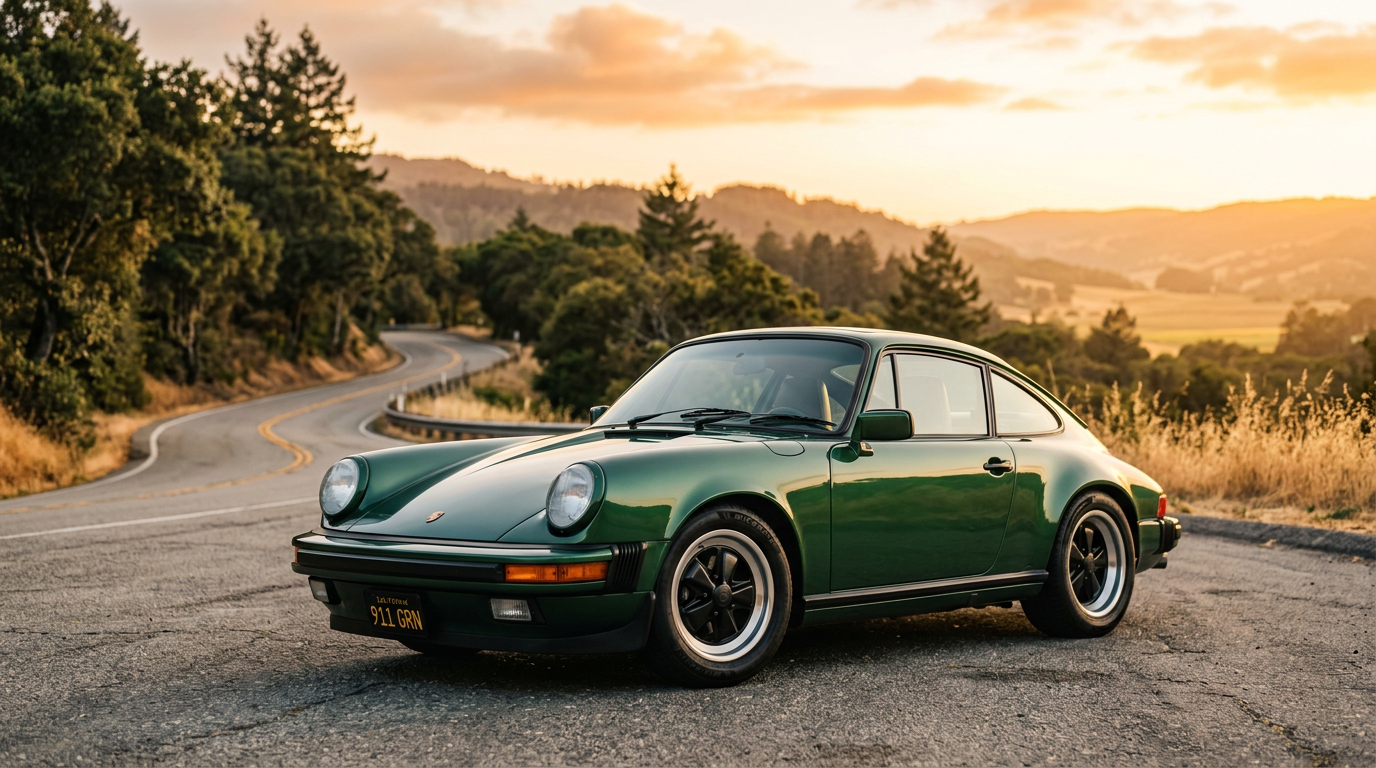
The Porsche 911 is the most successful sports car ever built - and in the world of classic cars, it is the single most traded, most discussed, and most consistently appreciating model in Europe. Over sixty years after the first 911 left Stuttgart-Zuffenhausen, the air-cooled generations remain the benchmark against which every other classic sports car is measured.
From the original 1964 model through to the 993 - the last air-cooled car, which rolled off the line in 1998 - every generation tells a different story and carries a different price tag. The pan-European perspective matters here: the same car can cost twenty percent more or less depending on which country you find it in.
Europe is the 911's natural habitat. The largest concentration of air-cooled examples exists across Germany, the Netherlands, the United Kingdom, and Italy - and prices between these markets can differ by twenty percent or more for the same car. That cross-border reality is precisely why a European search matters.
Browse Porsche 911 listings across Europe on Carseto →
A Brief History of the Porsche 911
When Ferdinand "Butzi" Porsche penned the 901 in the early 1960s, he was designing a successor to the four-cylinder 356 that would define his family's company for the next half-century. Peugeot owned the rights to three-digit model numbers with a zero in the middle, so the 901 became the 911 before production began - a small administrative change that created one of the most recognisable names in automotive history.
The original concept was simple and radical in equal measure: a rear-mounted, air-cooled flat-six engine, a lightweight body, and an uncompromising focus on driving purity. That formula remained fundamentally unchanged for thirty-four years. The air-cooled era - 1964 to 1998 - produced four distinct generations, each building on the last while preserving the essential character that makes a 911 immediately recognisable from the driver's seat.
The line drawn at 1998 is not arbitrary. That year, the 996 generation introduced water-cooling, a new body platform, and cost-shared headlights with the Boxster. For many enthusiasts, the air-cooled era represents the "real" 911, and the market reflects that: a clean 993 Carrera S will cost two or three times more than an equivalent-age 996. The focus here is exclusively on the air-cooled cars - the ones that matter most to collectors.
Generation-by-Generation Breakdown
There are hundreds of Porsche 911s listed on Carseto right now.
From €35,000 project cars to concours RS 2.7s across Germany, the UK, and Italy.
The Original 911 and 912 (1964–1973)
The earliest 911s are where the legend begins. The short-wheelbase cars (1964–1968) with their sharp handling, thin chrome bumpers, and small windows are the purest expression of the original design. From 1969, the wheelbase was lengthened by 57mm, calming the handling and broadening the car's appeal.
Key variants span a wide range. The 911T (Touring) was the entry-level model, with a detuned engine producing around 110 hp. The 911E (Einspritzung - injection) offered Bosch mechanical fuel injection and a more comfortable specification. The 911S was the sporting flagship, with higher compression, larger valves, and a firmer setup. At the top sits the 1973 Carrera RS 2.7 - the homologation special with its ducktail spoiler, lightened body, and the 2.7-litre flat-six that would define an era. The RS 2.7 is the apex of pre-impact-bumper 911 collecting, with European prices ranging from €500,000 to well over €1,000,000 for verified lightweight (Leichtbau) examples.
The 912, produced from 1965 to 1969, shares the 911 body with a four-cylinder engine from the outgoing 356. Once dismissed as the poor relation, the 912 has gained significant collector interest. Clean examples now command €40,000–€80,000 - a fraction of an equivalent 911, but appreciating rapidly.
What to check: Rust is the primary concern on all early 911s. The rain channels running along the roof gutters are notorious. Front wing lower edges, floor pans (particularly around the pedal box and under the rear seats), rocker panels, and the battery box area all trap moisture. Matching numbers - engine, gearbox, and body - carry a 15–30% premium, and provenance is everything. Request the Porsche Certificate of Authenticity before travelling to inspect.
European price ranges:
- Project / heavy restoration: €50,000–€100,000 (911T/E)
- Driver quality: €100,000–€180,000 (911S)
- Excellent / highly original: €180,000–€350,000 (911S)
- Concours / RS 2.7: €500,000–€1,200,000+
View the Porsche 911 Price Guide on Carseto →
G-Body / Impact Bumper 911 (1974–1989)
The 1974 model year brought the most visible external change in 911 history: the "impact bumpers." Mandated by US safety regulations, the concertina rubber bumpers replaced the delicate chrome blades of the earlier cars. Purists protested. Forty years later, the impact-bumper cars have developed their own devoted following.
This era spans three key models. The Carrera 3.0 (1976–1977) was the first car to revive the Carrera name since the RS 2.7, offering 200 hp and the newly galvanised body that dramatically improved corrosion resistance. The 911 SC (Super Carrera, 1978–1983) consolidated the range into a single 3.0-litre model producing 180–204 hp across its production run - it is widely considered the most reliable air-cooled 911 ever made. And the 3.2 Carrera (1984–1989), with its 231 hp 3.2-litre engine, is the sweet spot of the impact-bumper era: the last mechanically fuel-injected 911, robust, well-developed, and available in huge numbers across Europe.
The 930 Turbo deserves its own paragraph. Introduced in 1975 with a 3.0-litre turbocharged flat-six producing 260 hp (later 300 hp in 3.3-litre form), it was the fastest production car of its era. The 930 is legendary - and demanding. Turbo lag at low RPM followed by explosive mid-range boost requires a driver who knows what they are doing. The rear-heavy weight distribution and narrow rear tyres on early models earned the car a fearsome reputation. Today, the 930 Turbo commands €100,000–€200,000 for good examples, with Flatnose (Flachbau) variants reaching €300,000+.
The 3.2 Carrera is the volume market for classic 911 buyers. With European prices of €60,000–€120,000 for well-sorted examples, it offers the definitive air-cooled experience at a price that does not require a second mortgage. Parts supply is excellent - Porsche Classic manufactures and stocks over 60,000 parts for air-cooled models. The galvanised body (from 1976 onwards) means rust is less endemic than on earlier cars, though jacking points, door bottoms, and the front wing/bumper junction still require inspection.
Inspection priorities: The Carrera chain tensioner is the single most critical mechanical item on pre-1984 SCs. Failure is catastrophic and expensive. On the 3.2 Carrera, check for oil leaks around the chain housing and cam covers - not unusual, but should be monitored. The Turbo demands a compression test and boost-leak test before purchase.
European price ranges (3.2 Carrera):
- Project: €35,000–€55,000
- Driver quality: €60,000–€90,000
- Excellent: €90,000–€120,000
- Concours: €120,000–€160,000
The 964 (1989–1994)
The 964 was the first 911 to receive power steering, ABS, and coil-spring rear suspension - a major departure from the torsion bars that had defined the 911 chassis since 1964. Approximately 63,000 were built in total, making it less common than either the G-body or the 993.
The range offered Carrera 2 (rear-wheel drive) and Carrera 4 (the first all-wheel-drive 911), both powered by a 3.6-litre flat-six producing 250 hp. The Turbo (3.3-litre, later 3.6-litre) continued the 930's tradition with improved manners. At the top, the Carrera RS (lightweight, naturally aspirated, stripped-out) has become one of the most sought-after modern 911 variants, with European prices comfortably exceeding €200,000.
The 964 spent years as the undervalued generation. It was too modern for collectors who wanted chrome bumpers and too old for those who wanted the 993's refinement. That era is over. The 964 has appreciated dramatically since 2018, driven by buyers who recognise its raw, analogue character and its position as the last "simple" 911 - the last one you can work on without specialist diagnostic equipment.
Common issues: The dual-mass flywheel is a known failure point - replacement runs €3,000–€5,000. Oil leaks from cylinder head gaskets and cam cover seals are endemic on higher-mileage examples. The power steering pump can fail, and the air-conditioning compressor brackets are prone to cracking. None of these are terminal, but all should be factored into the purchase price.
European price ranges:
- Driver quality (Carrera 2): €70,000–€110,000
- Excellent: €110,000–€150,000
- Carrera RS: €200,000–€350,000
- Turbo: €120,000–€200,000
The 993 (1994–1998) - The Last Air-Cooled
The 993 is the most refined air-cooled 911 and, for many enthusiasts, the finest 911 of any era. Its multi-link rear suspension finally solved the 911's tendency toward lift-off oversteer without diluting the driving experience. The 3.6-litre flat-six produced 272 hp in naturally aspirated form, making it the fastest standard 911 Porsche had built.
The range was the broadest yet. The Carrera and Carrera S (wider body, Turbo brakes) formed the core. The Targa introduced a sliding glass roof - a love-it-or-hate-it design. The Turbo (408 hp twin-turbo, all-wheel drive) was the fastest production Porsche of its day. And the GT2 - a rear-drive, twin-turbo, lightweight homologation car - sits at the very top of 993 collecting, with prices now exceeding €1,000,000 for the best examples.
The "last air-cooled" premium is real and shows no sign of fading. Collectors understand that Porsche will never build another air-cooled flat-six, and the 993 represents the ultimate evolution of that engine. The Carrera S, with its wider body and visual impact, has emerged as a particularly strong performer in recent years - offering the Turbo look without the Turbo maintenance complexity.
Common issues: Second-gear synchromesh wear is the 993's signature mechanical complaint - it manifests as a crunch or resistance when shifting into second, particularly when cold. The VarioCam chain tensioners should be inspected. On Turbo models, the coolant pipes running through the centre of the car can corrode - a potentially catastrophic failure if undetected. Inspect thoroughly.
European price ranges:
- Carrera (driver quality): €100,000–€140,000
- Carrera S (excellent): €150,000–€200,000
- Turbo: €200,000–€350,000
- GT2: €800,000–€1,200,000+
Explore the Porsche 911 Price Guide →
What Drives 911 Prices Across Europe
See how 911 values trend over time on the Carseto Index.
Compare generations and spot the best entry points for your budget.
Condition is the dominant factor. The classic car market uses a four-tier grading system - Project, Driver, Excellent, and Concours - and the price differential between tiers is substantial. A Driver-grade 993 Carrera might trade for €110,000; a Concours example of the same year and specification can exceed €200,000.
Matching numbers matter enormously. A 911 with its original engine, gearbox, and body - verified through the Porsche Certificate of Authenticity (COA) - commands a 15–30% premium over an otherwise identical car with a replacement engine. For early cars and RS models, the premium is higher still.
Colour is an increasingly influential factor. Period-correct "special order" colours - Signal Green, Conda Green, Gulf Blue, Viper Green, Rubystone Red - can add 10–20% to a car's value. Paint-to-sample (PTS) cars are even more desirable. Conversely, white and silver cars in standard specifications tend to trade at the bottom of their condition bracket.
Market geography matters. German-supplied cars, particularly those with complete Scheckheft (service book) history, are considered the gold standard. US-specification reimports require careful assessment - different bumpers, emissions equipment, and lighting. Middle Eastern and Japanese cars can be excellent but may have non-European specifications. Within Europe, the price differential between Germany (often the cheapest large market) and the UK (traditionally the most expensive) can reach 15–20% for the same car.
Browse all Porsche 911 listings →
Common Mechanical Issues and Rust Spots
Rust is the 911's oldest enemy. On pre-1976 cars (before galvanised bodies), inspect the following areas with a torch and a magnet:
Rain channels along the roof - these trap water and corrode from the inside out, often invisibly until the problem is advanced. Front wing lower edges - where the wing meets the bumper and the A-pillar, moisture collects and rot develops. Rocker panels and sills - structural components that are expensive to repair properly. Floor pans - particularly around the pedal box, under the rear seats, and in the luggage compartment. The battery box - acid spills accelerate corrosion. The windscreen surround - check for bubbling paint and evidence of filler.
On post-1976 galvanised cars, rust is less common but not eliminated. Jacking points, door bottoms, and any area where the galvanising has been damaged (stone chips, accident repairs) remain vulnerable.
Mechanically, the chain tensioner is the most critical item on SC and 3.2 Carrera engines. The original design used a through-bolt tensioner that can fail without warning. Updated spring-loaded tensioners are a standard upgrade - verify it has been done. On 964 and 993 engines, oil leaks from the cam covers, cylinder bases, and rear main seal are common and should be assessed for severity. A light weep is normal on a flat-six with 100,000 km; a steady drip is not.
Gearbox synchromesh wear - particularly on second gear - affects all generations but is most noticeable on the 993. Cold crunching is the symptom; rebuild costs run €2,000–€4,000 depending on the box.
Running Costs and Maintenance
The Porsche 911 is not a cheap car to maintain, but it is not as expensive as its reputation suggests. An annual service at an independent air-cooled specialist costs €500–€1,000 depending on the generation and scope. Major services (valve adjustments, timing chain inspection on older cars) run higher.
Insurance varies significantly by market. The UK offers competitive agreed-value classic car insurance from specialists like Hagerty, Peter Best, and Adrian Flux. Germany's H-Kennzeichen system provides tax and insurance benefits for cars over thirty years old - an annual saving of several hundred euros. In Poland, agreed-value classic car insurance is less established, but providers like PZU and Wiener offer collector-friendly policies.
Parts availability is excellent. Porsche Classic maintains a catalogue of over 60,000 genuine parts for air-cooled models, and the independent aftermarket is extensive. Even esoteric items for early long-hood cars can be sourced through the specialist network.
Storage is a consideration. Air-cooled 911s benefit from dry, ventilated storage during winter months - particularly in Northern Europe. A dedicated car cover and a battery conditioner are minimum requirements. Climate-controlled storage is ideal for investment-grade examples.
Investment Outlook - Which 911s Are Appreciating Fastest
The Porsche 911 has outperformed most asset classes over the past decade, but not every model appreciates at the same rate.
Blue-chip investments: The Carrera RS 2.7 and the 993 GT2 have proven themselves as collector-grade investments with long-term appreciation trajectories. These are cars where provenance and condition are paramount, and where six-figure sums are the starting point.
Accessible appreciators: The 3.2 Carrera and the 964 Carrera 2 represent the middle ground - cars that have appreciated 40–60% over the past five years while remaining usable, enjoyable, and supported by an extensive parts and specialist network. These are the cars that reward buyers who want to use their investment.
The next breakout model: The 993 Carrera S is increasingly cited as the car with the strongest growth potential. Its combination of the wide Turbo body, naturally aspirated engine, and "last of the air-cooled" status creates a compelling collector narrative. Current prices of €150,000–€200,000 for excellent examples may look like a bargain in five years.
A note on the 996: The first water-cooled 911 has crossed the thirty-year threshold and is entering classic territory. It offers the lowest entry point of any 911 - €25,000–€50,000 for a Carrera - but the IMS (intermediate shaft bearing) failure risk is real and well-documented. A pre-purchase inspection and IMS bearing upgrade are non-negotiable for any 996 purchase.
Where to Buy a Classic 911 in Europe
The Porsche 911 market is deeply liquid across Europe, with specialist dealers in every major market.
Germany is the largest source market. German-supplied cars with Scheckheft histories are the gold standard, and prices tend to be 10–15% below the UK for equivalent cars. Many German specialists list their inventory online, and English is widely spoken in the trade.
The United Kingdom has Europe's deepest specialist infrastructure - from RPM Technik and Autofarm to JZM and Paragon. UK prices are typically the highest in Europe, but the buying experience is well-regulated and buyer protections are strong.
The Netherlands punches above its weight in the air-cooled Porsche world, with a strong club scene and competitive prices. Belgium, Italy, and France all offer opportunities, particularly for LHD examples.
The cross-border opportunity is Carseto's reason for existing. The same 1989 3.2 Carrera Sport can trade for £85,000 in the UK and €72,000 in Germany. A 993 Carrera that costs €140,000 in the Netherlands might be listed for €155,000 in the UK. Searching across borders is not a luxury - it is how informed buyers find the best cars at the right prices.
Auctions - Collecting Cars, RM Sotheby's, Bonhams, and Artcurial - offer transparency on pricing and provenance, but buyer premiums of 10–15% must be factored in.
Search Porsche 911s across 47 European countries on Carseto →
Pre-Purchase Inspection Checklist
Track your classic in My Garage.
Document your collection, get value insights, and list when you're ready to sell.
Before committing to any classic 911, work through these ten points. For cars over €50,000, commission an independent marque specialist inspection.
- Panel gaps and body alignment - 911s have tight panel fitment from the factory. Uneven gaps suggest previous accident damage or poor restoration.
- Engine oil condition - pull the dipstick. Look for clean oil at the correct level. Emulsion (milky residue) on the oil filler cap suggests head gasket issues.
- Compression test - essential. Cylinders should read within 10% of each other. Low or uneven readings indicate worn bores or valve issues.
- Gearbox feel - run through all gears with the engine cold. Second-gear crunch is the classic tell. Check reverse for whine.
- Suspension bushes - grab each wheel at 12 and 6 o'clock and rock. Excessive play indicates worn bushes, ball joints, or wheel bearings.
- Brake condition - check disc thickness, pad depth, and caliper operation. Feel for pulsing or pulling during the road test.
- Electrics - test every switch, light, and gauge. Instrument cluster backlighting, window regulators, and heated rear screen are common failure points.
- Interior originality - check seat condition, dashboard cracks, headlining sag, and carpet wear. Original Porsche interiors add value; poor retrimming detracts.
- Documentation - Porsche COA, service book, invoices, MOT/TÜV history. A complete paper trail is worth thousands.
- Road test - drive for at least 30 minutes, including cold start. Listen for chain rattle on start-up (tensioner), check oil pressure gauge stabilisation, and feel for tracking straightness.
Frequently Asked Questions
Which Porsche 911 generation is the best to buy? It depends on your priorities. The 3.2 Carrera offers the best value and the widest ownership experience for most buyers. The 993 is the most refined driving experience. The early long-hood cars are the purest, but the most expensive and demanding to maintain.
How much does a classic Porsche 911 cost in Europe? Entry points start around €35,000 for a 3.2 Carrera project, rising to €100,000–€150,000 for a well-sorted 993 Carrera. At the top, early RS models and the 993 GT2 exceed €500,000.
Is a Porsche 911 a good investment? The air-cooled 911 has been one of the strongest-performing collector cars over the past decade. Original-specification, low-mileage examples with documented history appreciate most reliably. Modified or poorly restored cars carry significantly more risk.
What is the cheapest classic 911 to buy? The 3.2 Carrera (1984–1989) offers the lowest entry point for an air-cooled 911. Projects can be found from €35,000, and well-sorted drivers from €60,000. Below that, the water-cooled 996 starts around €25,000, though it divides opinion on whether it is a "true" classic 911.
Should I buy a 964 or a 993? The 964 is rawer, more analogue, and more affordable. The 993 is more refined, better-handling, and carries the "last air-cooled" premium. If you value driving purity and lower entry cost, the 964. If you want the ultimate air-cooled grand tourer, the 993.
What to look for when buying a Porsche 996? The IMS (intermediate shaft bearing) is the critical concern. Verify whether the bearing has been upgraded - if not, budget €2,000–€3,000 for the work. Check for bore scoring (common on later M96 engines) and RMS (rear main seal) leaks. Beyond these model-specific issues, standard 911 checks apply.
The 911 Is More Than Metal
The classic Porsche 911 is one of those rare objects that improves with age - both in the way it drives and in what it represents. It is a car that rewards knowledge, that connects its owner to a global community of enthusiasts, and that has proven itself as both a driving companion and a store of value across decades.
First air-cooled 911 or fifth - the European market offers more choice, more variety, and more opportunity than any single country can match. The trick is knowing where to look.
Start your search on Carseto →
Thinking of selling your Porsche 911? List it on Carseto →
Related reading: Alfa Romeo Spider Buyer's Guide · Mercedes W113 Pagoda Price Guide
This article is part of the Carseto Journal - market intelligence and stories from Europe's classic car world.