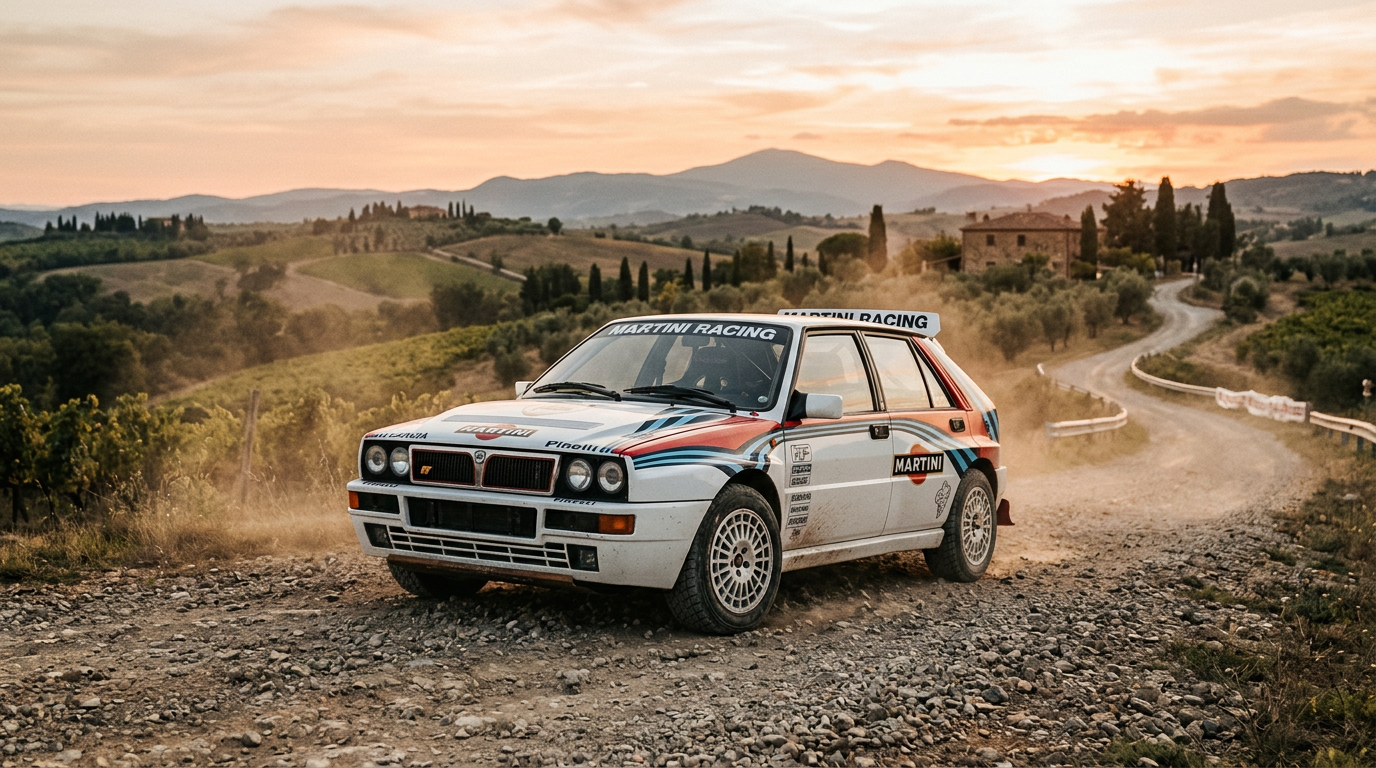
No manufacturer in history has a motorsport record to match Lancia's. Eleven World Rally Championship manufacturers' titles - more than anyone else. A legacy that stretches from the Lancia Lambda on the roads of the Mille Miglia to the Delta Integrale dominating the forests of Finland. That competition DNA runs through every Lancia ever made, but two models carry it more visibly than any other: the Fulvia Coupe, the car that won the 1972 Monte Carlo Rally and the first-ever WRC championship in 1974, and the Delta Integrale, the car that won six consecutive titles from 1987 to 1992.
These are not just collector cars. They are motorsport monuments that happen to have number plates. What follows covers both: their history, their variants, their prices across Europe, and the singular challenge that defines Lancia ownership more than anything else - rust.
Browse Lancia listings on Carseto →
Part One: The Lancia Fulvia Coupe
History and Significance
The Fulvia Coupe appeared in 1965 as a smaller, sportier companion to the Fulvia sedan. Designed in-house at Lancia (before the Fiat takeover), it featured a narrow-angle V4 engine, front-wheel drive, and a poise in corners that belied its modest dimensions. In 1972, Sandro Munari drove a Fulvia HF 1.6 to victory in the Monte Carlo Rally - the first of Lancia's many WRC triumphs. In 1974, the Fulvia helped Lancia win the inaugural World Rally Championship manufacturers' title.
Production ran from 1965 to 1976 across two series. Approximately 140,000 Fulvia Coupes were built in total - a generous number, though survival rates have been cut dramatically by the car's greatest weakness.
Variant Guide
Series 1 (1965-1970) is the more collectible series. The body is lighter, the proportions are purer, and the connection to Lancia's pre-Fiat identity is stronger. Key engine variants:
- 1.2 HF (1,216cc, 80 hp): the entry point. Adequate performance, the lightest kerb weight.
- 1.3 / 1.3S (1,298cc, 87-90 hp): better mid-range torque. The 1.3S (Rally) is the most sought-after non-1.6 variant.
- 1.6 HF (1,584cc, 114-130 hp): the motorsport derivative. Wider track, flared arches, five-speed gearbox. This is the one that won Monte Carlo. European prices for genuine 1.6 HF Series 1 cars range from €35,000 to €80,000 depending on condition and provenance. Rally-history cars command multiples.
Series 2 (1970-1976) introduced a revised front end with rectangular headlamps, improved ventilation, and emission-control modifications that reduced power slightly. The Series 2 is less collectible than the Series 1 but more affordable and still a thoroughly rewarding car to own and drive. Prices: €15,000-€35,000 for good examples in 1.3 or 1.6 specification.
What to Look For
Rust. The Fulvia rusts with a thoroughness that even by Italian standards is remarkable. Floor pans, inner sills, front subframe mounts, door bottoms, front wings (particularly around the headlamp bowls), rear arches, and the boot floor are all vulnerable. The structure is of monocoque construction - compromised structural members affect safety and are expensive to repair properly. A full body restoration on a Fulvia runs €10,000-€25,000 depending on severity.
Engine. The V4 is a characterful and robust unit when maintained. Check for oil leaks (cam covers, timing chain housing), timing chain condition (rattle on cold start), and coolant weep from the head gasket. The 1.6 HF engine is particularly strong but parts are more expensive than for smaller-capacity variants.
Gearbox. Synchromesh wear on second gear is common. The five-speed (1.6 HF) is more desirable than the four-speed.
Electrics. Period Italian wiring. Budget for inspection and potential rewiring on any car over forty years old.
Browse Lancia Fulvia listings on Carseto →
Part Two: The Lancia Delta Integrale
Six Consecutive Championships
The Delta Integrale's competition record speaks for itself: World Rally Championship manufacturers' titles in 1987, 1988, 1989, 1990, 1991, and 1992. No manufacturer has matched this streak, and in the era of modern regulations and manufacturer-backed factory teams, none ever will. The Integrale was the car that made all-wheel-drive turbocharged rally cars the standard - and then dominated the category it created.
The road car evolved in lockstep with the rally programme. Each variant was wider, more powerful, and more aggressive than the last.
Variant Guide
HF Integrale 8v (1987-1989). The original. A 2.0-litre turbocharged four-cylinder producing 185 PS, driving all four wheels through a viscous-coupling centre differential. Approximately 10,000 were built. The 8v is the lightest Integrale, with the most communicative steering and the purest driving feel. It is the enthusiast's choice - raw, immediate, and unfiltered.
European pricing: €30,000-€55,000 for good examples. Projects start lower, but rust repair costs on Integrales are consistently underestimated.
HF Integrale 16v (1989-1991). A new 16-valve cylinder head raised power to 200 PS. Wider wheel arches and a more aggressive stance distinguish the 16v visually. The 16v is the version most people picture when they think "Integrale." It balances the 8v's rawness with improved refinement and more usable power delivery.
European pricing: €40,000-€70,000 for good examples.
Evoluzione I (1991-1992). Wider still, with adjustable dampers, 210 PS, and a more developed chassis. The Evo I is where the Integrale becomes a genuinely rapid modern car rather than a characterful period piece.
European pricing: €55,000-€90,000.
Evoluzione II (1993-1994). The ultimate specification. 215 PS, Recaro front seats, revised dashboard, a distinctive rooftop spoiler, and the widest body of the range. Approximately 5,000 were built. The Evo II is the Integrale that commands six-figure prices - and increasingly gets them.
European pricing: €80,000-€130,000 for standard cars. Dealers Special and Martini 6 editions exceed €150,000 for the best examples.
Browse Lancia Delta Integrale listings on Carseto →
The Rust Question
There is no delicate way to address this: every Lancia Delta Integrale rusts. The question is not whether but where and how badly. The critical areas, in order of structural importance:
Inner front wings. Mud and water thrown up by the front wheels collects between the inner and outer wings. Corrosion develops invisibly and spreads to the front subframe mounts.
Sills and jacking points. Structural members that carry torsional loads. Compromised sills affect the car's rigidity and safety. Repair costs: €2,000-€4,000 per side for proper welded replacement.
Rear wheel arches. The most visible area of corrosion. Blistering paint along the arch lip is the early warning; structural perforation follows.
Floor around the rear differential mounting. Water ingress and road salt attack the floor pan around the rear diff. This area is critical - the rear subframe mounts through this section.
The honest truth: Budget €3,000-€8,000 for rust remediation on even a presentable Integrale. A car described as "solid" in an advertisement may still require significant metalwork once it is stripped and inspected properly. Pre-purchase inspection on a ramp - preferably by a Lancia specialist - is absolutely non-negotiable.
Mechanical Concerns
Engine. The 2.0-litre turbocharged four-cylinder is fundamentally strong, but it operates under significant stress. Check for head gasket weep (oil or coolant traces around the head-to-block joint), timing belt condition (service due every 36,000 km or 3 years - failure is catastrophic on this interference engine), and turbo condition. The original Garrett T3 turbo is robust but wears with age; aftermarket replacements are common.
Driveline. The viscous coupling centre differential and the front and rear differentials are all stressed components. Transfer box wear manifests as noise and vibration under load. Rebuilds cost €1,000-€2,000. The viscous coupling can be tested by jacking one wheel and checking for differential action - a seized coupling is an expensive replacement.
Interior. Alcantara deteriorates with UV exposure and wear. Replacement Alcantara trim is expensive (€1,000+ per seat retrim). Recaro seats on Evo models are increasingly valuable - a good set of Evo II Recaros is worth €3,000-€5,000 on its own.
The Lancia Challenge - And Why It's Worth It
Owning a Lancia - either a Fulvia or an Integrale - is not the easiest path in classic car collecting. Parts supply is constrained compared to Porsche, BMW, or Mercedes. Specialists are fewer in number. Rust is a constant, not a variable. And the marque's post-Fiat history - a long decline through the 1990s and 2000s - means there is no factory heritage programme to fall back on.
And yet. The Fulvia and the Integrale deliver driving experiences that no amount of engineering precision from Stuttgart or Munich can quite replicate. There is a directness, an honesty, and a mechanical intimacy to these cars that rewards the owner who is willing to invest the time, the care, and - yes - the money that Lancia ownership demands.
The Integrale, in particular, offers something that has no equivalent in the modern car market: the sensation of driving a world championship-winning rally car on public roads, with all the mechanical feedback, the turbo surge, and the all-wheel-drive traction that implies. No modern hot hatch, no matter how sophisticated its electronics, delivers this experience. The Integrale does it with analogue purity.
Where to Buy
The best Lancias are in Italy
Italian-market cars benefit from dry climate and lower prices. Search Italian Lancia listings on Carseto.
Italy is the largest source market for both the Fulvia and the Integrale. Italian-market cars benefit from the dry climate (less rust - though not no rust). Pricing in Italy is typically 15-20% below UK equivalents. The Italian specialist network is strong, particularly in Piedmont (Lancia's home region) and Emilia-Romagna.
The United Kingdom has a devoted Lancia community and strong aftermarket support. Specialists operate across the country. UK prices are the highest in Europe but reflect the quality of preparation and documentation that the UK market demands.
Germany offers well-maintained examples, particularly of the Integrale. H-Kennzeichen registration provides tax and insurance benefits for older models.
The cross-border opportunity: An Integrale 16v that costs £55,000 in the UK can sometimes be found for €45,000-€50,000 in Italy. For the Fulvia, Italian-market cars with less rust offer a better starting point for restoration than Northern European examples.
Search Lancia listings across Europe on Carseto →
Frequently Asked Questions
How much does a Lancia Delta Integrale cost? 8v models start around €30,000 for good examples. 16v: €40,000-€70,000. Evo I: €55,000-€90,000. Evo II: €80,000-€130,000+. Dealers Special and Martini editions command further premiums.
Is the Lancia Delta Integrale a good investment? The Integrale has appreciated consistently over the past decade, with Evo models now firmly in six-figure territory. The 8v, as the most affordable variant, offers the strongest growth potential at current prices. The Integrale's motorsport heritage and limited production underpin sustained collector demand.
Which Integrale should I buy? For driving purity and value: the 8v. For the definitive Integrale experience: the 16v. For the ultimate specification: the Evo II. For investment: the rarest special editions (Dealers Special, Martini 6).
How much does a Lancia Fulvia cost? Series 2 cars in good condition start around €15,000. Series 1 1.3S models: €20,000-€40,000. The 1.6 HF: €35,000-€80,000 depending on provenance and condition.
Do all Lancias rust? Yes. Both the Fulvia and the Integrale are structurally vulnerable to corrosion. A thorough inspection underneath - on a ramp, by a specialist - is essential before any purchase. Budget for rust remediation as part of the acquisition cost.
Rally Legends, Road Cars
Track your Lancia in your Garage
Add your Fulvia or Integrale to your Carseto Garage - track its value, document its history, and share it with the community.
The Lancia Fulvia and Delta Integrale are not cars for everyone. They demand more of their owners than a Porsche or a BMW - more attention, more expertise, more willingness to accept imperfection alongside brilliance. But for collectors who value motorsport heritage, mechanical purity, and a driving experience that no modern car can replicate, they offer something irreplaceable.
Start your search on Carseto →
Related reading: Alfa Romeo Spider Buyer's Guide · 10 Classic Cars Under €30,000 · Importing a Classic Car from Italy
This article is part of the Carseto Journal - market intelligence and stories from Europe's classic car world.