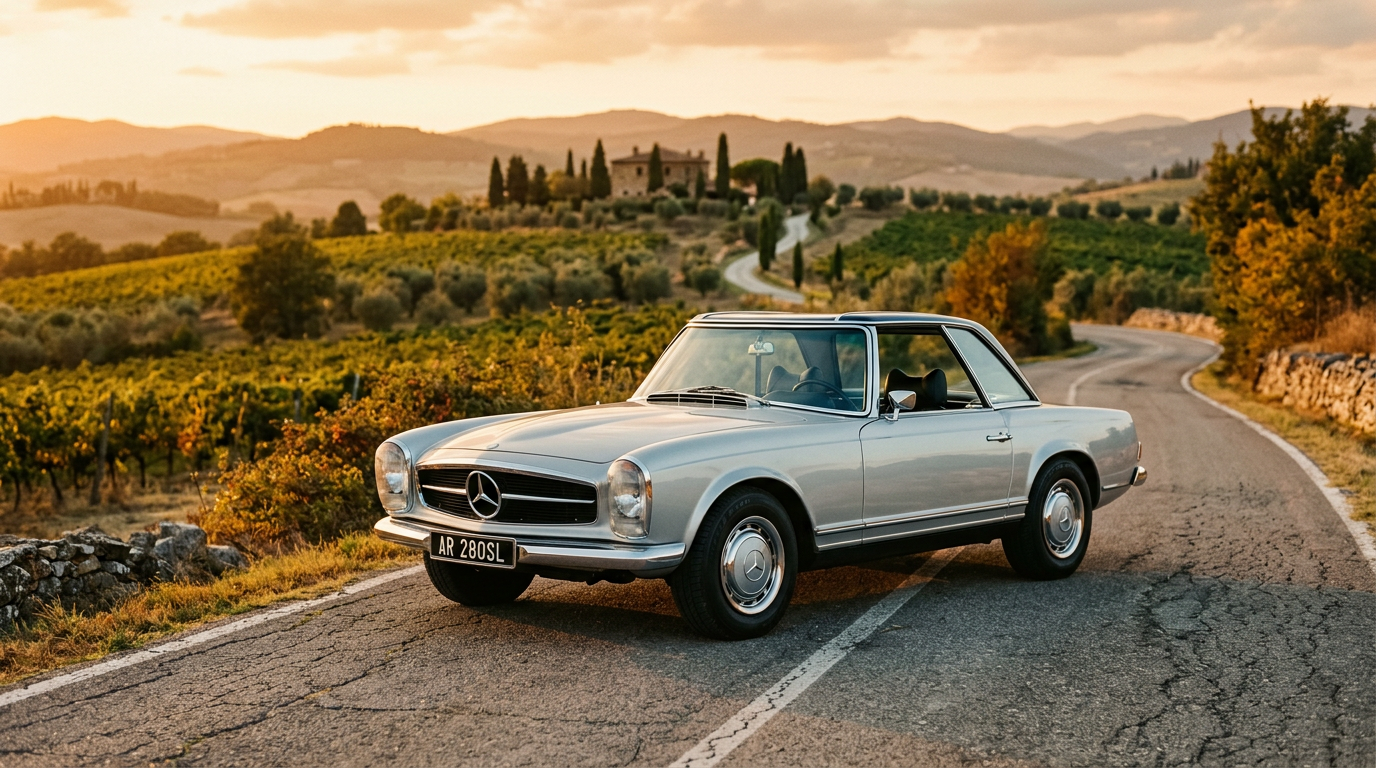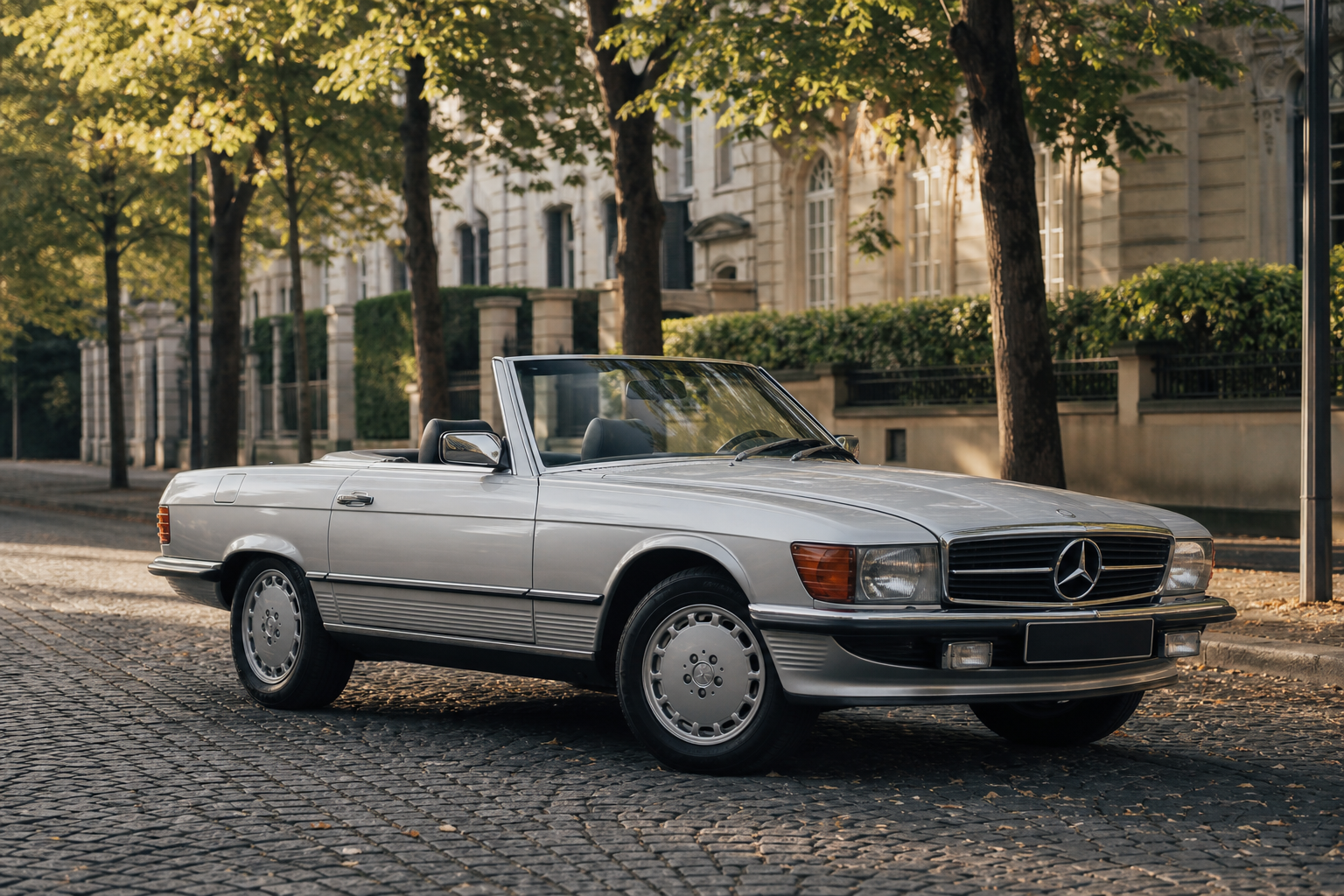
The Mercedes-Benz R107 SL was produced from 1971 to 1989, an eighteen-year production run that made it one of the longest-lived models in Mercedes-Benz history. Over 237,000 units were built, making it by far the most common SL variant and, consequently, the most accessible route into SL ownership.
The R107 is not a sports car in the way that a Porsche 911 is a sports car. It does not corner on rails or invite you to explore its limits. What it offers instead is something more subtle and, for many owners, more valuable: effortless, refined open-air motoring with the solidity and engineering integrity that defined Mercedes-Benz at its best. The R107 is a car for people who have outgrown the need to impress and simply want to enjoy the drive.
In 2026, the R107 sits in a sweet spot. Values have risen from their 2015 lows (when decent examples could be found for €15,000), but the car remains affordable relative to the W113 Pagoda and the R129 that succeeded it. At current prices, it is one of the smartest buys in the European classic car market.
Browse Mercedes SL listings on Carseto →
The Engine Range
Browse Mercedes SL listings across Europe on Carseto.
From 280 SL six-cylinders to 500 SL V8s in Germany, the UK, and Southern Europe.
The R107's engine lineup evolved across its eighteen-year production run, spanning six-cylinder and V8 options in multiple displacements.
280 SL (1974–1985). The 2.8-litre M110 inline-six producing 185 hp. The smallest engine in the range, but also the smoothest and most fuel-efficient. The 280 SL is the European enthusiast's R107: light, balanced, and rewarding on B-roads. It is also the most affordable variant to buy and maintain. European prices: €20,000–€45,000.
300 SL (1986–1989). The 3.0-litre M103 inline-six replaced the 280 SL in the final years of production. More refined, with electronic fuel injection and better torque. The 300 SL benefits from late-production improvements to build quality and corrosion protection. European prices: €25,000–€50,000.
350 SL / 380 SL / 420 SL. The V8 variants offered for European and US markets. The 350 SL (3.5-litre M116, 200 hp) was the volume seller. The 380 SL and 420 SL provided incremental upgrades. These are the cruising R107s, built for effortless torque and relaxed driving. European prices: €22,000–€50,000.
450 SL (1973–1980). The 4.5-litre M117 V8 with 225 hp. The most powerful early R107 and the quintessential boulevard cruiser. Popular in the US market, where the majority were sold. European prices: €25,000–€55,000.
500 SL (1980–1989). The 5.0-litre M117 V8 with 240 hp. The ultimate R107 specification: effortless performance, beautiful torque delivery, and a presence that the six-cylinder cars cannot quite match. The 500 SL is the collector's R107 and commands the highest prices. European prices: €35,000–€70,000, with exceptional examples reaching €80,000+.
560 SL (1986–1989). Sold only in the US, Japan, and Australia. The 5.6-litre V8 with 230 hp (US spec, catalysed). Not officially sold in Europe, but grey-market imports exist. Desirable for its specification but less common in the European market.
What to Look For
Rust
The R107 was galvanised from the factory, and its corrosion resistance is significantly better than the W113 Pagoda or the W123. However, eighteen years of production and thirty-five to fifty-five years of age mean rust is still a concern.
Priority inspection areas: The floor pans (particularly around the seatbelt mounting points and under the rear carpet), the boot floor (water ingress through the boot seal), the inner sills (probe from below), the area around the front subframe mounts, and the lower edges of the doors. The hardtop mounting points on the rear parcel shelf are a specific R107 vulnerability; check for corrosion around the mounting holes.
The good news: R107 body panels are available through Mercedes-Benz Classic and specialist suppliers. The bad news: rust repair on any car of this age is labour-intensive and expensive if the damage has reached structural members.
Automatic Gearbox
The vast majority of R107 SLs (over ninety percent of European-market cars) are automatics. The automatic gearboxes fitted across the production run are Mercedes-Benz units (722.3 and later variants) that are fundamentally robust. Check fluid colour (should be red/pink, not brown or black), shift quality (smooth, decisive, no slipping), and converter engagement (the lock-up should activate smoothly at cruising speed).
Manual-transmission R107s exist but are extremely rare (primarily 280 SL variants in European specification). A genuine manual R107 commands a 30–50% premium over an equivalent automatic.
Hardtop
Every R107 left the factory with both a soft top and a removable hardtop. A missing hardtop reduces value by €1,000–€3,000. Replacement hardtops are available but not cheap. The hardtop's rear window can delaminate on cars stored in direct sunlight; check for crazing or hazing.
Engine-Specific Issues
Six-cylinder (M110, M103): Head gasket weep is common on higher-mileage examples. Timing chain wear manifests as rattle on cold start-up. The single-row timing chain on early M110 engines is a known weakness, and upgrading to a double-row chain is a standard modification. The M103 (300 SL) is the most modern and trouble-free six-cylinder.
V8 (M116, M117): Timing chain and guide rail wear is the most common V8 issue. Failed chain guides can cause catastrophic engine damage. Listen for chain rattle on cold start-up; any rattle justifies a guide inspection. Rebuild of timing chain, guides, and tensioners costs €1,500–€3,000 at a specialist.
Running Costs
The R107 is one of the most affordable classic Mercedes to maintain. The engines are well-understood, parts are universally available through Mercedes-Benz Classic and the extensive independent aftermarket, and the car's mechanical simplicity (relative to modern vehicles) makes it DIY-friendly for competent home mechanics.
Annual servicing at an independent specialist: €400–€800. The R107 does not demand the attention or the budget of a Porsche or a Ferrari. It asks only for regular care and repays with decades of reliable service.
Insurance on an agreed-value basis is competitive. H-Kennzeichen registration in Germany provides the standard €191 flat tax and reduced insurance premiums.
R107 vs W113: Which SL?
See how Mercedes SL values trend on the Carseto Index.
Compare the R107 and W113 Pagoda and find the best entry point for your budget.
Every prospective SL buyer asks this question. The answer depends on priorities.
The W113 Pagoda is the more beautiful car, the more collectible, and the better investment. It is also twice to three times the price of an equivalent-condition R107 and significantly more expensive to maintain and restore. The Pagoda is a car for Heritage Custodians and Investor-Collectors.
The R107 is the more usable car. It is faster, more comfortable, safer, and better-suited to modern traffic. It is also dramatically more affordable to buy and maintain. The R107 is a car for Weekend Drivers and Nostalgia Seekers who want to use their classic regularly.
If you want to admire an SL: the Pagoda. If you want to drive one: the R107.
Where to Buy
Germany offers the widest selection and the most competitive pricing. The R107 is one of the most common H-Kennzeichen-registered vehicles in Germany, and specialist dealers carry deep inventory.
The United Kingdom has a strong R107 community. Prices are higher than in Germany but the specialist support infrastructure is excellent.
Southern Europe (Spain, Portugal, Southern France) produces dry-climate R107s with reduced rust, but check for sun damage to the soft top, interior, and paint.
Search Mercedes SL listings across Europe on Carseto →
Frequently Asked Questions
Track your classic in My Garage.
Document your collection, get value insights, and list when you're ready to sell.
How much does a Mercedes R107 SL cost? 280 SL: €20,000–€45,000. 500 SL: €35,000–€70,000. 300 SL (late production): €25,000–€50,000. Values depend primarily on condition, engine variant, and documentation.
Which R107 engine is best? For driving pleasure: the 280 SL (six-cylinder, lightweight, balanced). For effortless touring: the 500 SL (V8, smooth, torquey). For the best combination of modernity and reliability: the 300 SL (final six-cylinder, best-developed).
Is the R107 a good investment? The R107 has appreciated steadily, 30–40% over five years for good examples. The 500 SL and late-production 300 SL are the strongest performers. At current prices, the R107 offers genuine value relative to its build quality and driving experience.
Is the R107 reliable? Very. The Mercedes-Benz engines of this era are legendary for longevity. The automatic gearboxes are robust. Electrical systems are simpler than many contemporaries. Regular maintenance is all the R107 asks.
Effortless
The R107 does not demand attention or insist on being admired. It does not require special skills or heroic maintenance budgets. It simply does what Mercedes-Benz designed it to do: carry two people across a continent in comfort, style, and quiet mechanical confidence. There are faster classics, and more beautiful ones. There is nothing more effortlessly enjoyable to live with.
Related reading: Mercedes W113 Pagoda Price Guide · Mercedes W123 Buyer's Guide · Classic Car Insurance in Europe
Dieser Artikel ist Teil des Carseto Journals - Markteinblicke und Geschichten aus der Welt europäischer Klassiker.